


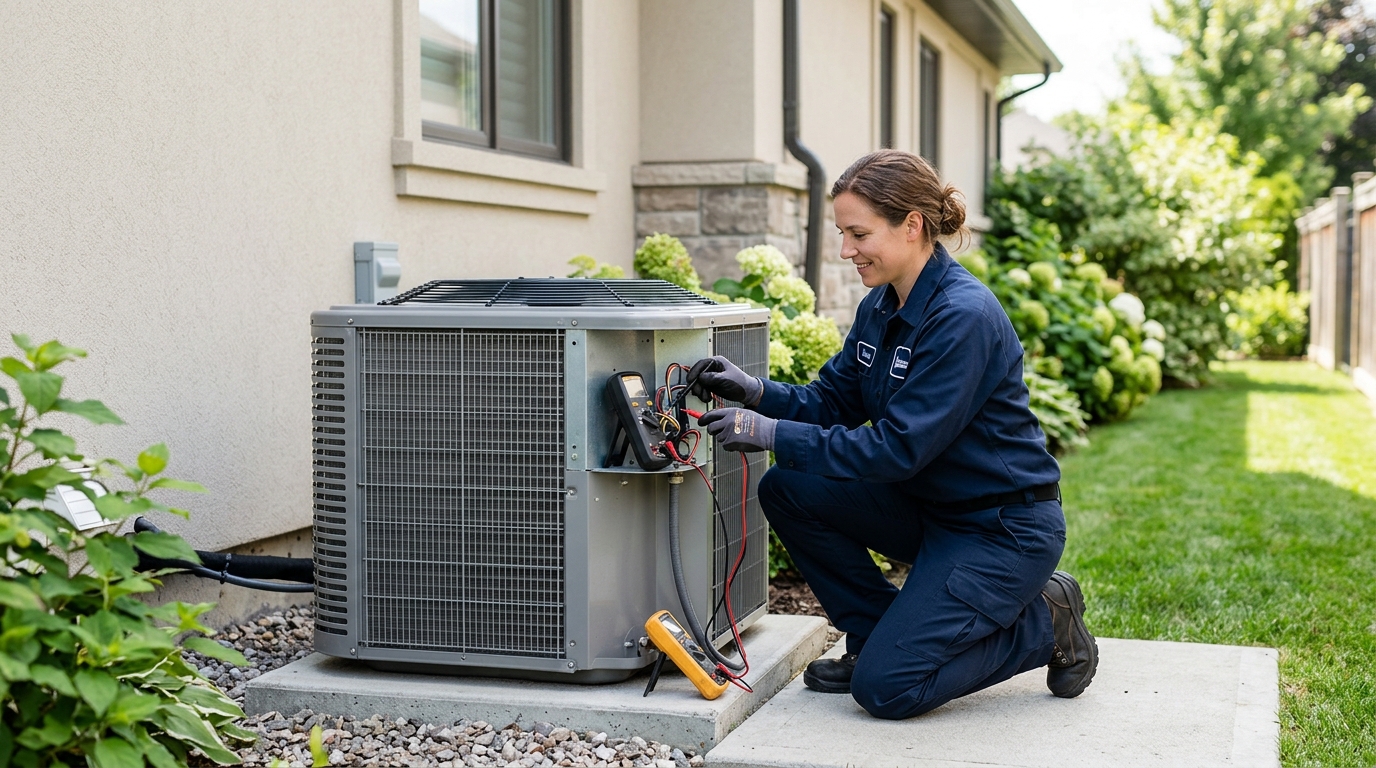
Louisiana summers don’t play fair, and your energy bills probably know it better than anyone. If you’re tired of watching your HVAC system struggle against triple-digit heat and swampy humidity while your utility costs climb, it’s time for a change. Energy star certified heat pumps offer a smarter path forward, one that keeps your home comfortable year-round without draining your wallet. This guide breaks down exactly what makes these systems worth your investment in 2026.
What Makes a Heat Pump Energy Star Certified
How Certification Standards Are Tested
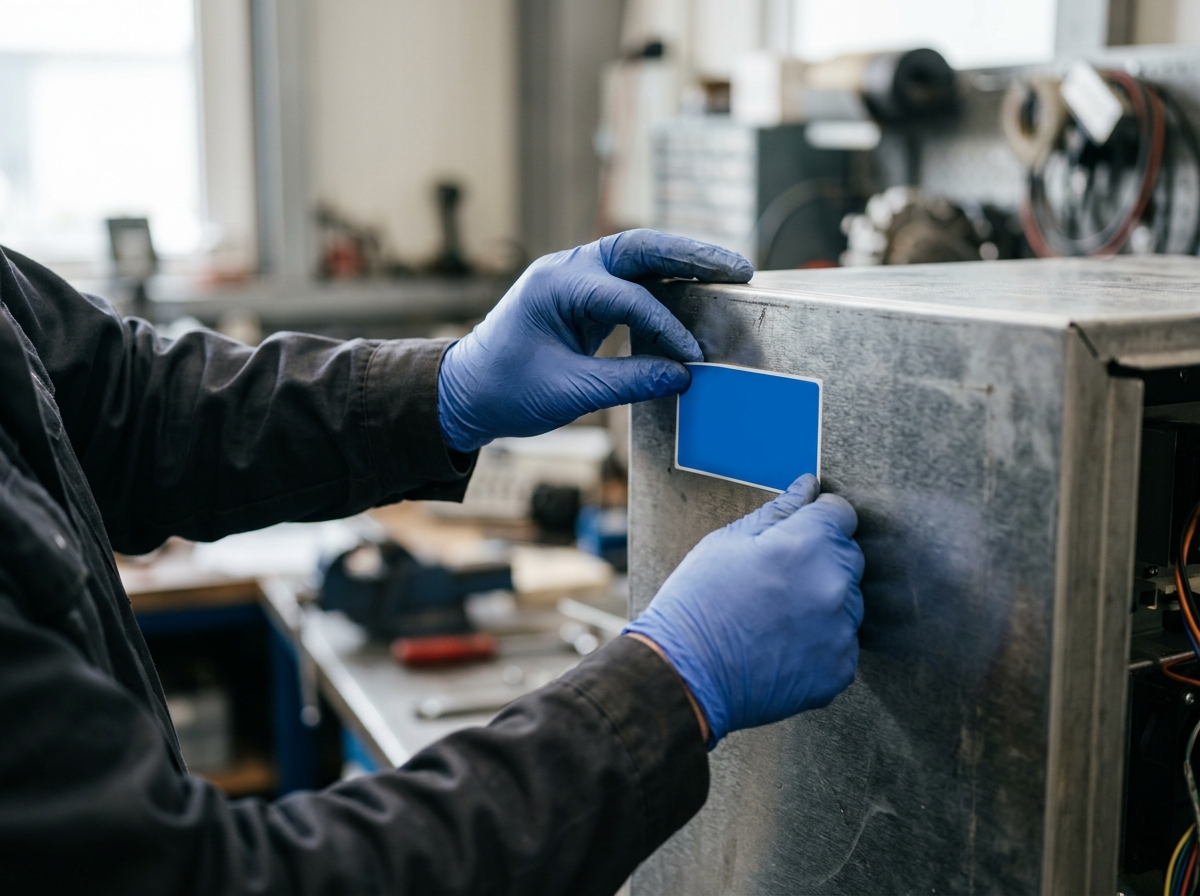
Getting the blue label isn’t a marketing decision. It’s a testing decision. Manufacturers must submit units to third-party labs that verify HSPF2 (heating efficiency), SEER2 (cooling efficiency), and EER2 (efficiency under peak heat load) ratings. Those numbers have to beat federal minimums by a meaningful margin, not just squeak by. The label only goes on equipment that’s been independently checked, not equipment the manufacturer simply claims performs well.
These aren’t lab fantasies, either. The tests simulate real climate swings, cycling behavior, and part-load performance, since most heat pumps run well below full capacity most of the year. Want the plain-language breakdown of what each rating actually measures? It’s worth reading a clear explainer on What Does ENERGY STAR® Mean? before you start comparing model numbers.
Certified units typically use 10 to 20 percent less energy than standard models while producing the exact same comfort. That gap adds up fast in Louisiana, where systems run nearly year-round.
Why the Label Matters Beyond the Sticker Price
Here’s the catch nobody puts on the sales tag: certification tests the equipment, not your house. A top-rated heat pump pushed through leaky, undersized ductwork loses a chunk of that efficiency before it ever reaches your living room. The rating tells you what the machine is capable of. It doesn’t tell you what you’ll actually get.
That’s why pairing a certified system with tightened ductwork and a sealed building envelope matters so much. Many homeowners researching this connection end up reading up on the benefits of insulating your attic, since attic heat gain or loss directly fights against whatever efficiency gains the new equipment promises. A great heat pump in a poorly sealed home is like a fuel-efficient car with a leaky gas tank.
The label also connects to a tier above standard certification: Most Efficient 2025-2026 recognition, reserved for the top-performing models within the certified pool. If you’re weighing options and want ongoing coverage of what’s changing in efficiency standards, many local businesses and curious homeowners alike keep tabs on the blog for updates. Chasing that top tier only pays off, though, if the rest of the house can hold onto the air it’s paying to condition.
How Heat Pumps Work and Why Efficiency Ratings Matter
Heating and Cooling in One System
A furnace burns fuel. Electric resistance heat just brute-forces warmth through a coil. A heat pump does neither — it grabs heat that already exists in the outside air and moves it indoors, then reverses the trick in summer to pull heat out of your house. Because it’s transferring energy instead of creating it, a heat pump can deliver three to four units of heat for every unit of electricity it uses. That’s the whole reason efficiency numbers on these systems look so different from a traditional furnace label.
One system, two jobs. That’s the appeal for a lot of Louisiana homeowners tired of running separate heating and cooling equipment. You get a single outdoor unit and a single indoor air handler doing both, which simplifies maintenance and, done right, simplifies your utility bill too.
Cold-Climate vs. Standard Heat Pumps
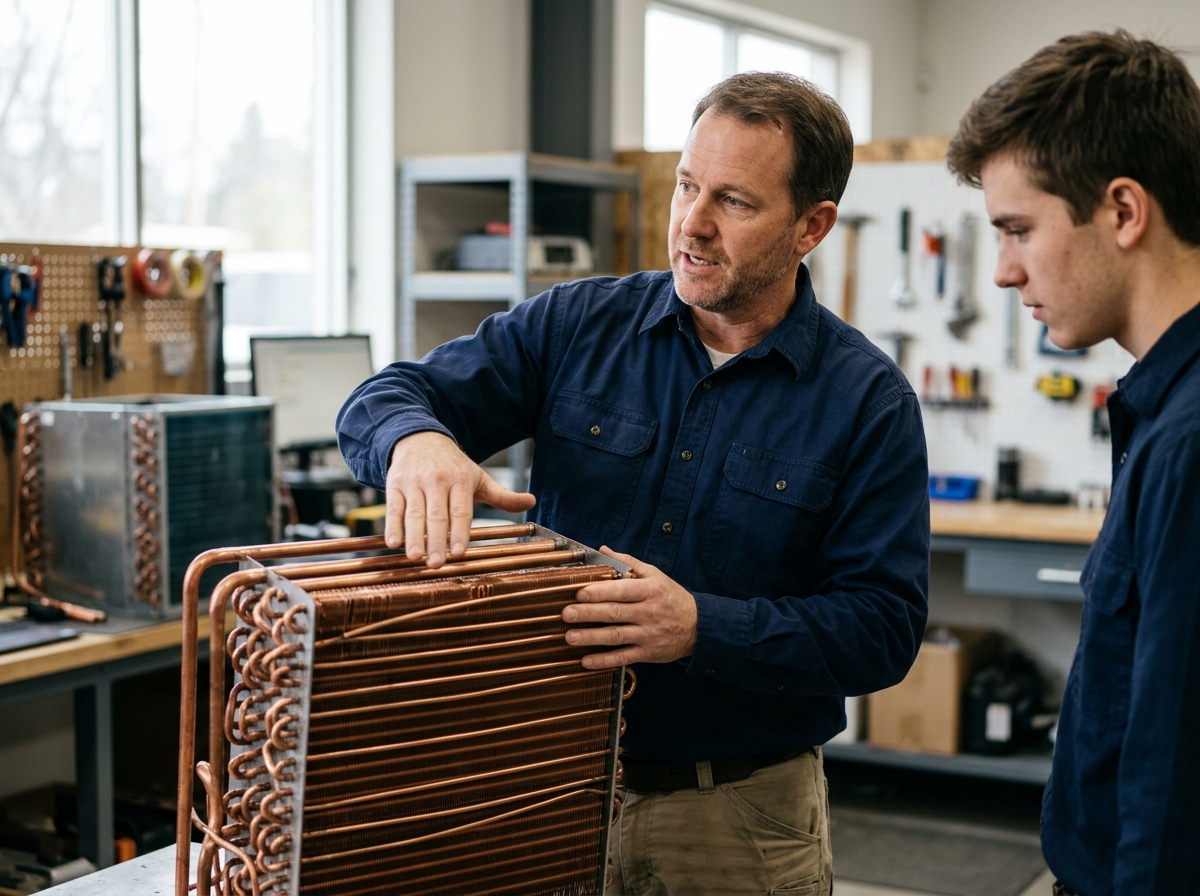
Cold-climate heat pumps are built to keep pulling usable heat from air down near zero degrees Fahrenheit, using variable-speed compressors and enhanced defrost cycles. It’s impressive engineering. It’s also overkill for most of Louisiana, where winter lows rarely stay below freezing for long. A standard efficiency heat pump handles our climate just fine and usually costs less upfront than the cold-climate version.
That price gap matters. Cold-climate models carry a premium for capabilities you’ll rarely tap in Shreveport, Baton Rouge, or New Orleans. A standard unit sized correctly for your home will cool efficiently all summer and heat comfortably through our short, mild winters without the extra cost of hardware designed for Minnesota.
Ductless Mini-Splits vs. Ducted Central Systems
Ductless mini-splits skip ductwork entirely, sending refrigerant lines directly to wall-mounted or ceiling cassette units in each room. They’re a smart fix for additions, garage conversions, or older homes without existing ducts. Ducted central heat pumps, on the other hand, use your home’s existing duct network to distribute conditioned air evenly, which tends to feel more seamless in a whole-house setup. Browsing options like the ENERGY STAR Certified Heat Pumps at Lowes.com gives you a sense of how many configurations of both types are available today.
Neither option is automatically better. It depends on your home’s layout, existing infrastructure, and budget.
Efficiency Ratings Only Matter With a Sealed, Insulated Home
Here’s the catch nobody puts on the sales brochure: a high-efficiency rating assumes the conditioned air actually stays where you put it. Leaky ducts, gaps around attic penetrations, and thin insulation can bleed off a huge share of that efficiency before it ever reaches your living room. Pairing blown in cellulose insulation with proper air sealing is often what separates a heat pump that performs on paper from one that performs in your actual house.
Windows play a role too. Even small upgrades like better window coverings can trim heat gain and loss, and resources like a guide to energy efficient window coverings are worth a homeowner’s time. A full picture of what’s needed, from duct condition to attic depth, usually starts with a proper assessment; browsing our services style offerings from any qualified provider is a reasonable first step. Buy the efficient equipment. Skip the sealing, and you’ve wasted half the investment.
Comparing Heat Pump Types and Efficiency Tiers
Standard vs. Ductless vs. Geothermal at a Glance
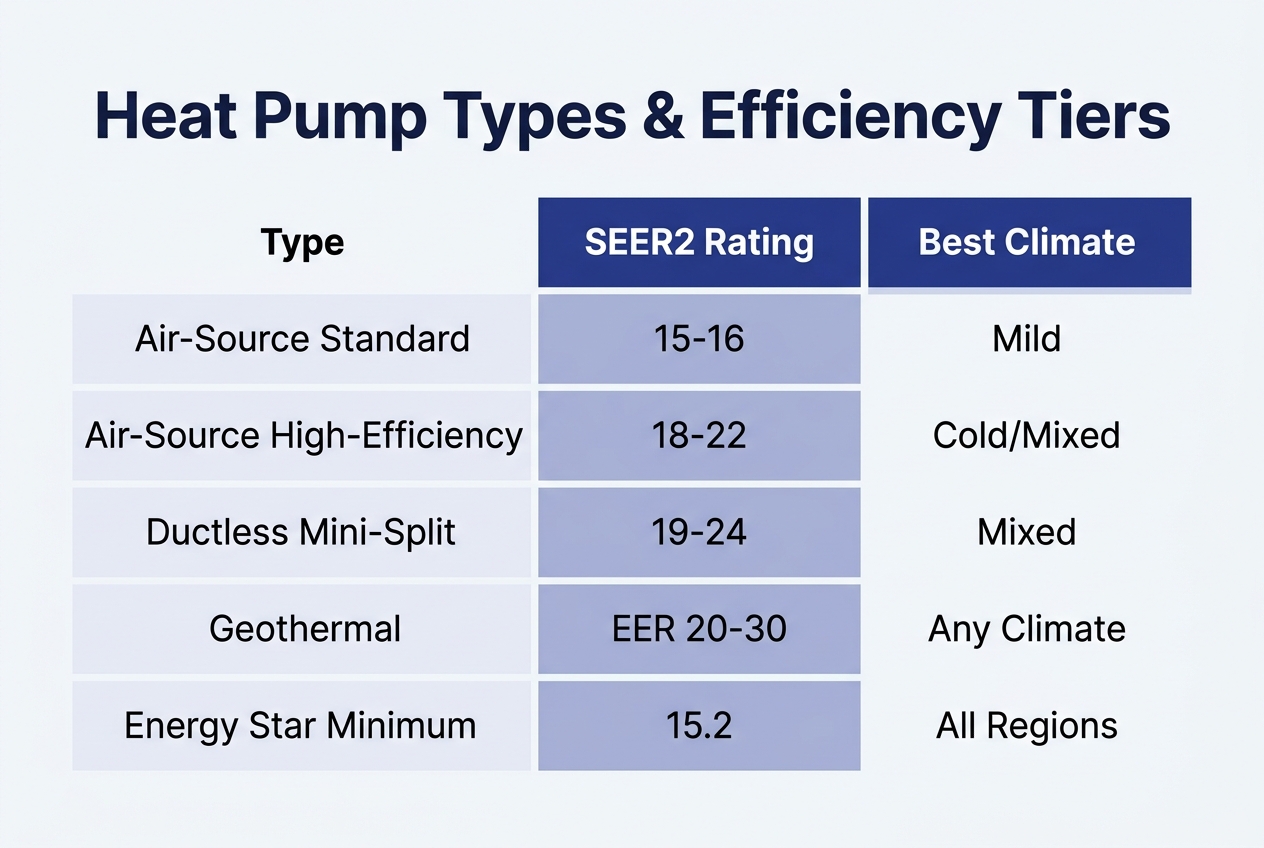
Not every heat pump fits every house. Before you settle on a system, it helps to see the three main types laid out side by side, since efficiency, upfront cost, and where the money goes actually vary quite a bit. The right choice depends on your home’s layout, not just the price tag on the unit.
| Type | Typical SEER2 / HSPF2 | Upfront Cost Tier | Best-Fit Home | Climate Suitability |
|---|---|---|---|---|
| Standard split-system (ducted) | 15.2–22 SEER2 / 7.8–10 HSPF2 | $$ | Homes with existing ductwork | Great for humid Gulf South summers |
| Ductless mini-split | 18–24 SEER2 / 9–12.5 HSPF2 | $$–$$$ | Additions, garages, older homes without ducts | Excellent, plus room-by-room zone control |
| Geothermal (ground-source) | Equivalent to 30+ SEER2 / 400%+ efficiency | $$$$ | New construction or larger lots | Outstanding year-round, unaffected by outdoor swings |
Geothermal wins on efficiency, no contest. It taps stable ground temperatures instead of fighting Louisiana’s 95-degree afternoons, but installation often means trenching or drilling, which pushes costs well above either alternative. Ductless mini-splits shine when you’re adding a sunroom, converting a garage, or dealing with one room that never cooperates with the thermostat. Standard ducted systems remain the default for most Gulf South homes simply because the infrastructure’s already there, and swapping in a higher-tier unit is far cheaper than starting from scratch. Whatever you choose, your bill depends heavily on rates, and reviewing the current cost of electricity in louisiana puts the payoff math in perspective. It’s also worth learning What does ENERGY STAR ® Mean for an HVAC System? before comparing model numbers, since certification standards shift the SEER2 baseline year to year.
Rebates and Incentive Programs Available Now
Federal Tax Credits Have Ended
Through the end of 2025, homeowners who installed a qualifying high-efficiency heat pump could claim a federal tax credit worth up to 30% of project cost, capped at $2,000. According to the IRS, that credit ended for equipment placed in service after December 31, 2025, so a heat pump installed in 2026 does not qualify. If your winter or summer bills already feel out of control, understanding why your electricity bill too high each season can help you decide whether a heat pump upgrade or weatherization should come first.
Regional Utility Rebate Programs
Regional utilities run their own rebate programs, and stacking them with weatherization can shrink your out-of-pocket cost dramatically. Income-eligible households often qualify for no-cost weatherization paired directly with these rebates, meaning sealing and insulation work happens before the heat pump ever gets sized. A few programs worth knowing:
- Entergy offers rebates tied to home energy assessments and qualifying HVAC upgrades for residential customers across its Louisiana and Mississippi service territory.
- CLECO provides incentives for high-efficiency equipment installations, often requiring proof of ENERGY STAR certification before payout.
- Mississippi Power runs seasonal rebate offers that reward customers who pair insulation upgrades with new heating and cooling systems.
- Atmos Energy focuses rebates on efficiency improvements that reduce overall household energy waste, including duct and air sealing.
- Energy Smart bundles assessments, weatherization, and equipment rebates into one streamlined application for qualifying homes.
Complicated paperwork is the top reason homeowners delay these upgrades altogether. Forms get lost, deadlines slip, and rebates expire unused. A BPI-certified provider knows exactly what documentation each program requires, which keeps submissions accurate the first time. You can learn more about us and how these programs get coordinated from start to finish.
Why a High-Efficiency Heat Pump Underperforms in a Leaky Home
Signs Your Home Is Wasting Heat Pump Efficiency
Here’s the uncomfortable truth: a shiny new heat pump can’t fix a house full of holes. Air leakage and duct leakage combined can waste 20 to 40 percent of your conditioned air before it ever reaches a living room or bedroom. That’s cooled or heated air pushed into attics, crawl spaces, and wall cavities instead of where you actually need it. No amount of equipment efficiency overcomes that kind of loss. Proper duct sealing often recovers a big chunk of that wasted output almost immediately.
An under-insulated attic makes the problem worse. When heat pours through a thin layer of attic insulation in July, or escapes through it in January, your system has to run longer cycles just to keep up. Longer cycles mean more wear, higher bills, and a shorter equipment lifespan. Even a top-tier heat pump rated for excellent seasonal efficiency will look mediocre on a power bill if it’s fighting an attic stuck at R-19 instead of R-38.
Uneven temperatures — a hot upstairs, a chilly back bedroom — usually aren’t an equipment problem at all. They’re an envelope problem. Rooms that never hit the thermostat setting almost always trace back to leaky ducts, gaps in the building shell, or insulation that’s thin, compressed, or missing altogether. Blaming the heat pump here is like blaming a good pair of shoes for a hole in your sock.
This is where testing beats guessing. A blower door test pressurizes the home and reveals exactly how much air is escaping, and where. A duct blaster test does the same for your duct system, pinpointing leaks at boots, joints, and connections that waste conditioned air before it reaches a single room. Together, these diagnostics turn vague complaints like “the bedroom’s always hot” into a specific, fixable list. Skip the testing, and you’re just throwing insulation and caulk at a problem you can’t actually see.
One more thing worth taking seriously: combustion safety. Tightening a home’s envelope changes how it breathes, and that matters for gas water heaters and furnaces that rely on proper draft to vent safely. A qualified technician checks that appliances still exhaust correctly once a home is sealed tighter, because a more efficient house should never come at the cost of indoor air safety. If you’re mid-project or planning one, keeping a provider’s contacts on hand makes it easy to schedule that follow-up check without delay.
Steps to Prepare Your Home Before Installing a New System
The Assess-Seal-Insulate-Verify Sequence
Buying a new heat pump before fixing what’s wrong with your house is like buying new shoes for a broken sidewalk. Skip the prep work and even the best equipment struggles to perform. There’s a logical order to getting your home ready, and jumping steps almost always costs you money later.
The table below lays out the six-step sequence, what happens at each stage, and why it matters before a technician ever touches your new system.
| Step | What Happens | Why It Matters |
|---|---|---|
| 1. Home energy assessment | Blower door and duct blaster tests measure air leakage in cubic feet per minute | Establishes a baseline number so you can prove improvement later |
| 2. Review findings | Thermal images and attic R-value readings get ranked by priority | Tells you which gaps and thin spots waste the most energy first |
| 3. Air sealing | Attics, rim joists, top plates, and duct joints get sealed | Stops conditioned air from leaking out before you add insulation |
| 4. Insulation upgrade | Blown-in cellulose added to reach R-38 or higher | Keeps sealed air where it belongs, cutting heat gain and loss |
| 5. Post-test verification | Blower door and duct blaster retests confirm leakage reduction | Proves the work actually reduced waste, not just looks like it did |
| 6. System sizing and install | A certified heat pump gets sized using Manual D load calculations | Prevents an oversized or undersized unit from running inefficiently |
Step 3 deserves extra attention, since sloppy work here undoes everything that follows. A proper review of air sealing techniques shows how much leakage hides in places homeowners never think to check. Once sealing and insulation are done and verified, you’re ready to shop. That’s the point to start browsing the Heat Pumps Results | EPA ENERGY STAR database for models that match your home’s actual load, not a guess. Get the order right, and the new system has a fair shot at hitting its efficiency numbers.
Choosing the Right System Size and Installer
Why Proper Sizing Beats Buying the Highest-Rated Unit
Bigger isn’t better. That’s the mistake a lot of homeowners make when shopping for a new heat pump. The right size comes from a room-by-room load calculation, not a rough guess based on square footage. An installer who skips this step is guessing, plain and simple, and that guess usually lands on the high side.
Here’s the problem with going too big: an oversized system blasts cold air, hits the thermostat setting fast, then shuts off. It never runs long enough to pull humidity out of the air. In the Gulf South, that means a house that feels cool but sticky. Short cycling like this also wears out compressors faster and drives up your electric bill even as comfort suffers. Correct sizing keeps run times long and steady, which is exactly what pulls moisture out of humid Louisiana air.
Questions to Ask Before You Sign
A qualified installer should follow ACCA Manual D standards for duct design and ASHRAE 62.2 guidelines for fresh-air ventilation. Reviewing the specifications listed under ENERGY STAR Certified Heat Pumps before you meet with a contractor gives you a baseline for comparing efficiency claims. BPI-certified Building Analyst Professionals bring diagnostic testing skills that most HVAC-only crews simply don’t offer.
Before signing anything, ask these questions:
- Did you perform a Manual J load calculation for this specific house, and can I see the numbers?
- Will you inspect and pressure-test the existing ductwork before recommending a new system size?
- How will you verify the home has adequate insulation, since work like attic insulation directly affects the load calculation and equipment sizing?
- What ventilation strategy will you use to meet fresh-air requirements once the home is sealed tighter?
- Can you provide before-and-after diagnostic reports, not just a verbal promise that things improved?
- What’s your plan if the installed system short-cycles or struggles with humidity after a few months?
If an installer can’t answer these clearly, keep looking. A confident answer costs nothing. A vague one costs you comfort later.
Before you invest in a new ENERGY STAR certified heat pump, make sure your home can actually hold onto the comfort it creates—that’s where the team at Big Star Conservation, Inc. comes in. Based right in Elmwood, Louisiana, their BPI-certified Building Analyst Professionals will assess your home’s air sealing and insulation to ensure your new system runs efficiently rather than fighting leaky ducts and drafty walls. Stop by their office at 1500 Edwards Ave Suite J, or call +1 (504) 305-3276 to book an appointment in under 5 minutes and get started on a warmer winter and cooler summer.
