


Your Entergy bill lands in August and the number doesn’t make sense. You’ve been reasonable with the thermostat. You keep the lights off. Still the charges climb. So what uses the most electricity in a home here in Louisiana — and which of those loads can you actually do something about? We’ll break down where your kilowatt-hours really go, room by room and system by system, then show you which fixes move the needle and which ones just feel productive.
Where Your Power Bill Actually Goes Each Month
National Averages vs. Gulf Coast Reality
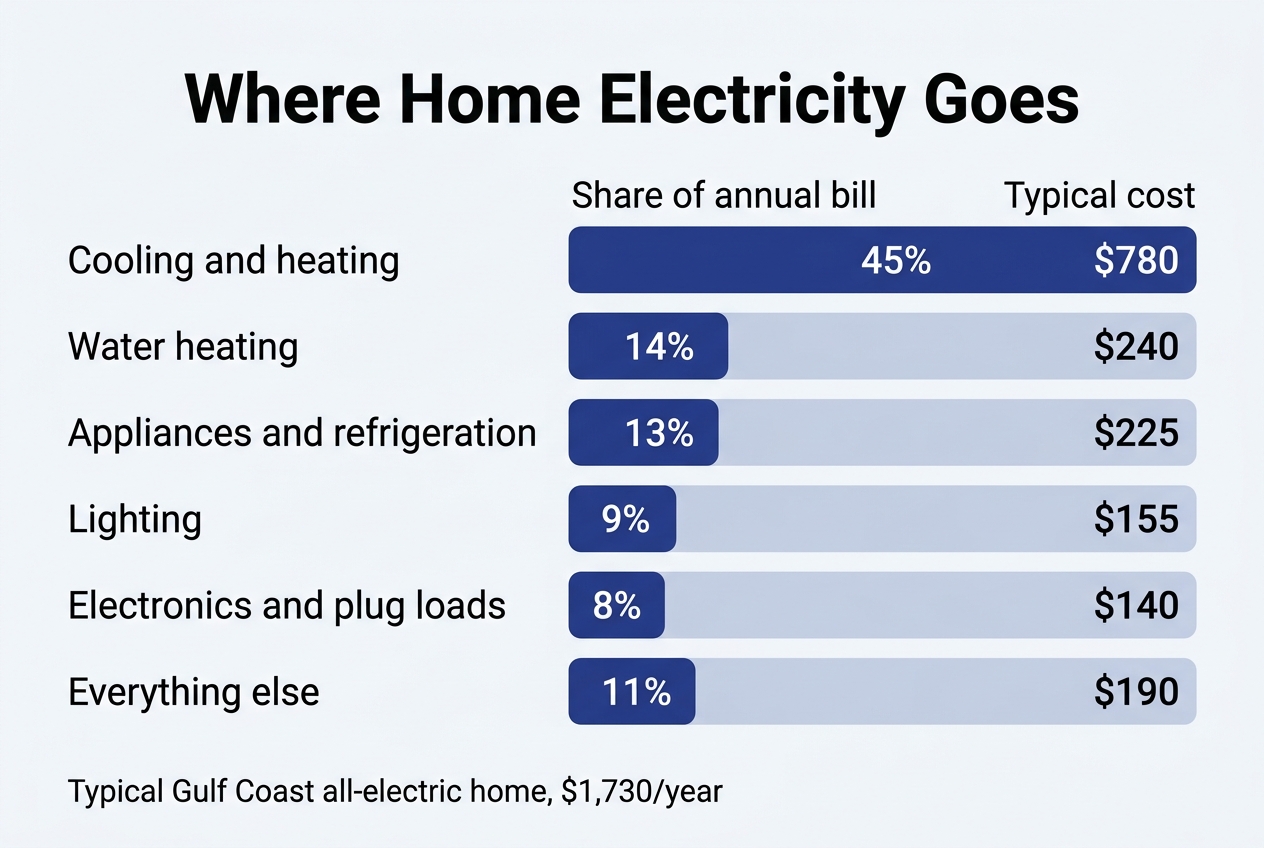
The standard breakdown for a U.S. home looks like this: heating and cooling take 40-50% of the bill, water heating runs 10-18%, appliances land around 8-15%, lighting eats 5-10%, and electronics account for 3-5%. That’s the national picture. It’s a decent starting point. But it was averaged across Minnesota basements and Arizona ranch houses alike.
Down here, the math tilts. Gulf South homes run AC from April into October, sometimes November, and humidity means the system keeps pulling moisture out of the air even when it isn’t blazing hot. Cooling can push past 55% of annual electric use in a leaky Louisiana house. If your electricity bill too high feeling hits hardest in August, that’s runtime talking.
Your own split will still differ from your neighbor’s. A gas water heater knocks 15% straight off your electric side. Square footage, how many people shower daily, and whether someone nudges the thermostat to 68 all shift the numbers.
Reading kWh on Your Entergy or CLECO Statement
Find the kilowatt-hours used line first. Then find your cost per kWh — most Louisiana residential rates sit in the 10 to 14 cent range once fuel adjustments are added. Multiply, and you’ve got the story. Now compare July or August against March and November, when the AC mostly sits idle. That gap is your cooling load, in dollars.
Here’s the part people get backwards. A hair dryer pulls 1,800 watts and terrifies everyone, but it runs six minutes. Your air handler pulls similar wattage and runs eight hours a day. Runtime drives cost, not nameplate wattage. Plenty of practical guides and homeowner explainers on this kind of blog make the same point, and it holds up every time you check the meter.
Track three months of kWh. Patterns show up fast.

The Biggest Electricity Users in a Home, Ranked by Cost
Cooling and Heating Dominate the List
In a Louisiana home, climate control isn’t just the biggest load. In a bad August it’s bigger than everything else combined. Central air conditioning and electric heat typically account for 40–50% of annual electricity use. A 3-ton AC unit pulls roughly 3,000–3,500 watts while the compressor runs, and in July it may run 12 hours a day. Electric water heating comes next at 10–18%, with a family of four keeping the elements firing three to five hours daily. Refrigerators and freezers land around 8–13% — small draw, endless runtime.
The table below ranks the usual suspects. Monthly costs assume a rate near the state average of about 12 cents per kilowatt-hour. If you want a firmer number, looking up the cost of electricity in louisiana for your own utility makes the math more honest.
| Appliance | Running Wattage | Typical Runtime | Est. Monthly Cost |
|---|---|---|---|
| Central AC (3-ton) | 3,000–3,500 W | 8–12 hrs/day (summer) | $90–$150 |
| Electric water heater | 4,500 W | 3–5 hrs/day | $22–$35 |
| Refrigerator + freezer | 150–400 W | 24/7 cycling | $12–$25 |
| Clothes dryer | 3,000–5,000 W | 1 hr, 5x/week | $8–$12 |
| Oven, dishwasher, lights, TVs, consoles | 50–3,000 W | Varies | $15–$30 |
Wattage vs. Hours: Why the Dryer Isn’t #1
Your dryer is one of the hungriest devices you own, yet it barely dents the bill. Cost equals watts times hours, and the dryer only runs a few hours a week. A pre-2001 refrigerator, meanwhile, can burn twice the power of a current ENERGY STAR model while humming along around the clock. Sizing and installation quality drive cooling costs hard too, a point echoed in contractor guidance on residential air conditioning installation and in federal appliance efficiency data. So aim at runtime first.
Chase the top two rows. Everything below them is rounding error, honestly. You can find contact and data-handling details in the site privacy policy if you’d rather read before you call anyone.
Why Your Cooling System Works Harder Than It Should
Attic Heat Gain and Duct Leakage
Your air conditioner doesn’t cost you money by existing. It costs you money by running. Runtime is the hidden expense, and air leakage plus thin insulation is what drives it up. A unit that should cycle off for twenty minutes an hour instead grinds along all afternoon — same amperage, same thermostat setting, just taking far longer to get there.
In July, a Louisiana attic can sit between 130 and 150°F by mid-afternoon. If the ceiling below it has 4 inches of settled insulation, that heat radiates down into your bedrooms for hours after sunset. That’s why the house still feels warm at 9 p.m. Adding depth to your attic insulation is the most direct way to slow that transfer, and depth should be verified, not estimated.
Then there’s the ductwork running through that oven. Leaky supply ducts dump cold air into the attic before it ever reaches a register, and homes commonly lose 20 to 30% of total airflow this way. The symptoms are predictable. The back bedroom never cools. Dust reappears on furniture within days. There’s a musty smell the moment the system kicks on. Stack effect makes it worse — warm air escaping high in the house pulls attic and crawl space air in low, through rim joists and floor penetrations.
What Diagnostic Testing Measures
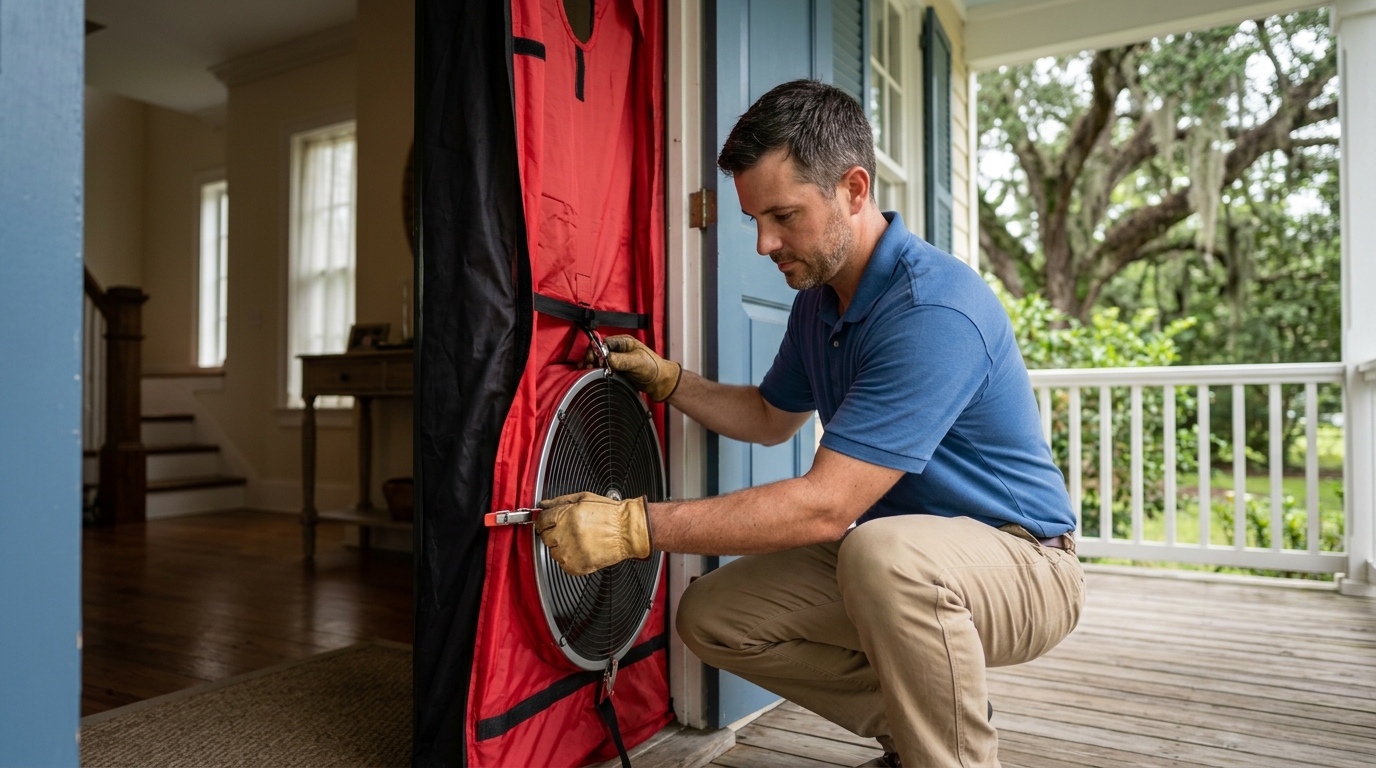
Guessing is expensive. A blower door test depressurizes the house and reports leakage in CFM50, so you get a real number instead of a hunch about drafty windows. A duct blaster test does the same for your duct system, measuring how much air escapes at operating pressure.
Those numbers tell you where to spend. Reading the about us details on BPI Building Analyst credentials helps clarify why pre- and post-test verification matters — the retest proves the leakage actually dropped. Equipment replacement is a separate conversation for a licensed HVAC contractor. Often an unnecessary one, once the leaks are closed.
Fixes That Cut Runtime on the Two Largest Loads
Cooling and water heating dominate the bill, so that’s where the work belongs. The order matters more than most people expect. Air sealing comes first — before insulation, before anything else — because blowing cellulose over open attic top plates just filters the air on its way out. Seal the penetrations, then insulate over them.
Sealing and Insulation Measures
Here’s what actually moves the needle on a Louisiana home, roughly in the order a crew would tackle it:
- Sealing attic top plates, recessed light cans, plumbing and wiring chases, rim joists, and the gaps behind window and door trim, which together often account for more leakage than every window in the house.
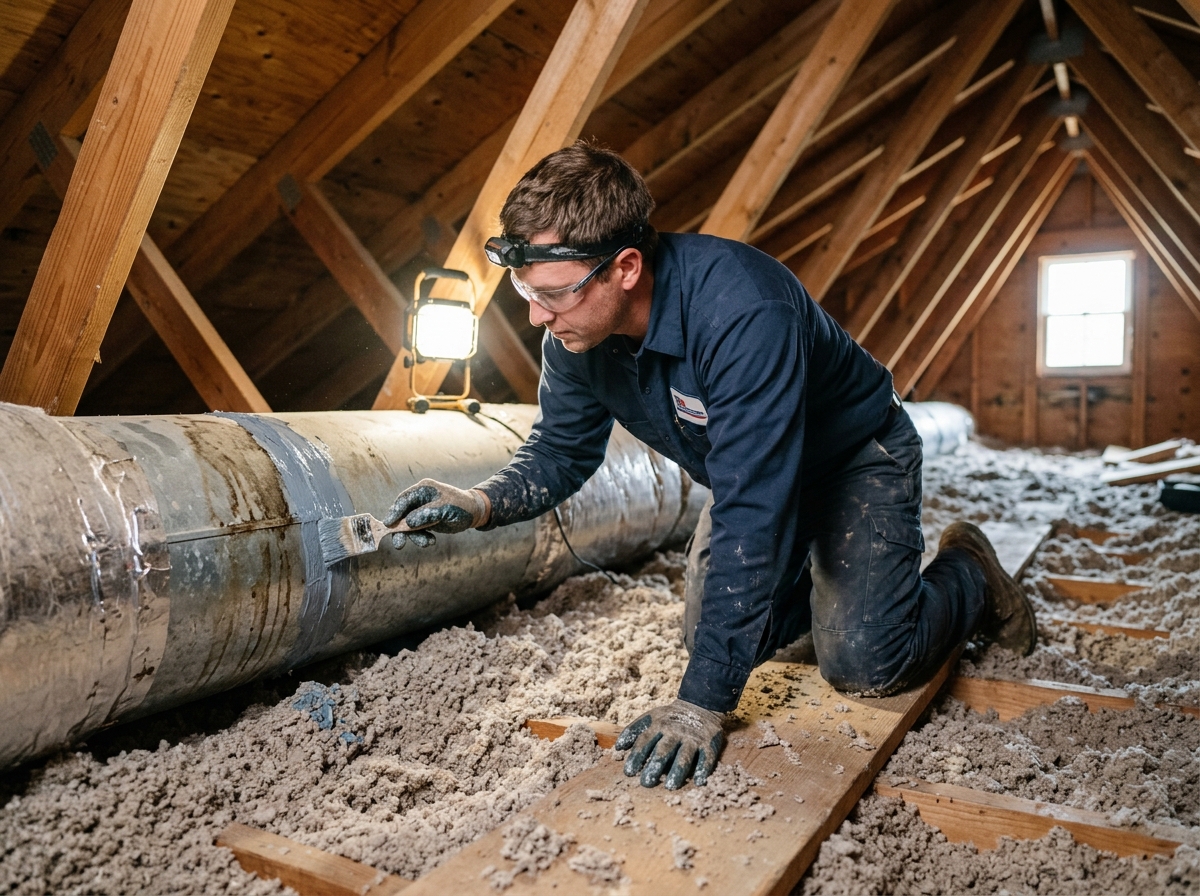
- Brush-on mastic or an aerosolized internal sealant on the ducts, paired with mechanical repair of disconnected boots and crushed flex runs — and if you want to understand how sealing leaky supply and return runs recovers lost airflow, the pre- and post-test flow pressure numbers tell the whole story.
- Blown-in cellulose to R-38 through R-60 in the attic, dense-packed into wall cavities and crawl spaces, with depth and R-value verified after the install rather than estimated.
- A combustion safety check once the house is tighter, confirming gas water heaters and furnaces still draft correctly instead of spilling exhaust back into the living space.
Tighten a house without verifying draft, and you’ve traded a bill problem for a safety problem. Don’t skip that step.
Low-Cost Steps You Can Do This Weekend
Water heating responds fast to small moves. Drop the setpoint to 120°F, wrap the tank, insulate the first six feet of hot and cold pipe, and install low-flow showerheads. Wash cold. Run the dishwasher only when it’s full. Swap remaining bulbs for LEDs, and put the TV cluster on a smart power strip so standby draw stops. If you’d rather have a professional map it out first, the scheduling contacts take about five minutes.
Upgrades Compared: What Each One Actually Saves
Not every upgrade pays you back at the same rate, and the price tag rarely tracks with the savings. Here’s how the common options stack up against the cooling and heating runtime that drives your bill.
| Measure | What it targets | Typical impact on electricity use | Who performs it |
|---|---|---|---|
| Air sealing + attic cellulose (to R-38–R-60) | Cooling and heating runtime, the largest load | 10–20% off annual bills; often utility-rebate eligible | BPI-certified weatherization crew |
| Duct sealing (mastic or aerosol) | Airflow lost into attics and crawlspaces | Recovers 15–30% of delivered air; usually fixes the hot room | BPI-certified weatherization crew |
| Replacement windows | Glass conduction and frame leaks | Low savings per dollar; long payback | Window installer |
| Spray foam or fiberglass batts | Attic and wall R-value | Similar R-value goal, higher cost or gappier fit | Foam or batt insulation contractor |
| New HVAC, duct replacement, solar PV | Equipment capacity and generation | Big savings, big price; size after the load drops | Licensed HVAC contractor or PV installer |
Windows get blamed for drafts they didn’t cause. Sealing frames, trim, and weatherstripping handles most of that cold-floor feeling for a fraction of replacement cost, and a blower-door retest puts a number on the change. If you’re weighing full replacement, know that air sealing is measured, not guessed.
Batts leave gaps around wiring and framing. Dense-pack cellulose settles into irregular cavities and gets depth-verified after the blow. Radiant barrier and attic ventilation are separate trades, and a thermal imaging scan plus an R-value check tells you whether sealing and cellulose beat them on measured savings. Examples of completed diagnostics appear in a contractor’s portfolio, worth a look before you commit. Shrink the load first. Everything after that gets cheaper.
How an Energy Assessment Finds Your Specific Money Leaks
Guessing is expensive. A BPI-certified Building Analyst walkthrough replaces the guesswork with numbers, and that’s the whole point. The assessment measures how leaky your house actually is, where conditioned air escapes, and how much insulation is really up there — not what the builder claimed in 1998. National utility guidance on which household loads dominate a monthly bill is useful context. But your house has its own answer.
The Diagnostic Tools and What Each Reveals
Each tool answers a different question. Together they build a picture the eye can’t see.
- Blower door test — depressurizes the house to measure total air leakage in CFM50, turning “it feels drafty” into a hard baseline you can compare against later.
- Duct blaster test — pressurizes the duct system to quantify leakage, since ducts running through a hot Louisiana attic can lose a quarter of what the air handler moves.
- Thermal imaging — shows missing insulation, wind-washed attic corners where airflow has stripped coverage, and cool damp spots that hint at moisture problems behind finishes.
- Smoke pencil on ducts — traces visible air movement at plenums, boots, and takeoffs, which is where most disconnects and gaps hide.
- Attic R-value measurement — depth readings across the attic plane, because settled insulation rated R-30 twenty years ago may be performing closer to R-19 today.
The output is a prioritized action plan tied to measured numbers. Understanding the benefits of insulating your attic helps you see why that item often lands at the top. Post-test verification reports then show the leakage reduction in CFM.
Conditions That Need Another Trade First
Some findings stop work cold, and they should. Standing water or crawl space moisture goes to a waterproofing contractor. Active rodent activity needs a pest professional. Mold requires licensed remediation, and contaminated or damaged existing insulation has to be removed separately before anything new goes in.
One clarification: this isn’t a HERS or RESNET rating for a home sale. That certificate requires a certified rater. A diagnostic assessment tells you where your money’s going. It doesn’t score your house for a closing table.
Paying for the Work: Utility Programs in Louisiana and Mississippi
Program Coverage and Eligibility
Here’s the part most homeowners don’t know: you probably aren’t paying full price. Regional efficiency programs run through Entergy, CLECO, Mississippi Power, Atmos Energy, and Energy Smart often cover most or all of the cost of an energy assessment, air sealing, duct sealing, and attic insulation. These programs exist because utilities would rather cut peak summer demand than build more generation. Your leaky attic is their problem too.
Income-eligible households frequently qualify at no cost whatsoever. Everyone else typically sees an out-of-pocket figure far below market rate — sometimes a few hundred dollars for work that would otherwise run into the thousands. Eligibility depends on your utility, household income, and whether the home is single-family or multi-family, so the numbers get confirmed before any work begins.
The paperwork side matters more than people expect. Rebate forms, pre- and post-test documentation, and incentive submissions all get filed on your behalf. No chasing forms weeks later. If you’ve ever mailed in a rebate and waited, you know why that’s worth something.
What the Visit Looks Like
Booking takes about five minutes by phone or text. Crews show up on time, wear shoe covers indoors, and clean up completely — no cellulose dust tracked down your hallway. Before anyone leaves, the blower door and duct blaster get run again, so you have hard numbers showing leakage reduction instead of a promise that things are better.
Targeted air sealing around attic penetrations, top plates, and rim joists usually delivers the biggest measured change, and it’s the step that makes new insulation actually perform. Combustion appliances get checked afterward to confirm water heaters and furnaces still draft safely in a tighter house.
Set fair expectations. You should see lower summer bills, rooms that hold closer to the thermostat setting, and noticeably less dust and pollen working its way inside. Knowing which household appliances consume the most power helps you judge what weatherization can and can’t fix — sealing won’t change a dryer’s draw. Questions go to 1500 Edwards Ave Suite J, Elmwood, LA 70123, or (504) 305-3276.
Before you commit to a quote, it’s worth asking what the numbers actually show: has anyone measured where the air is moving, checked attic R-value, or tested duct leakage before and after — or is the recommendation based on a walkthrough and a hunch? Foam, batts, new windows, and fresh ductwork all have their place, but they’re very different investments, and knowing which drafts come from a frame gap versus a genuinely failed assembly changes what’s worth spending on. A blower-door-backed assessment, honest talk about what the data says, and clear follow-up on rebate paperwork tend to matter more to how the job feels a year later than the material anyone happens to be selling.
