



Every summer, your thermostat setting stays the same but the bill keeps climbing. That’s not bad luck. It’s usually leaky ducts, gaps around doors, and thin attic insulation forcing your system to work overtime, and understanding what actually drives ac electricity usage is the first step to fixing it. This article breaks down where your cooling dollars really go and what you can do, starting now, to keep more of them.
Understanding AC Electricity Usage: What’s Normal and What’s Not
Why identical homes can have very different bills
Two houses on the same street, same square footage, same builder. One family pays $180 a month to stay cool. The other pays $310. Nothing about the thermostat setting explains that gap. Central AC usually eats up 40-50% of a summer electric bill in hot climates, so even small differences in how a system runs translate into real money fast. The variable isn’t always the equipment — it’s everything around it.
System age and size matter, sure. But so does the tightness of the home’s envelope, the condition of the ductwork hiding in the attic, and honestly, just habits — how often the thermostat gets bumped, doors left open, filters ignored. Usage varies enormously even between near-identical floor plans, which is why comparing your bill to a neighbor’s rarely tells you anything useful.
Here’s the tell: if your bill jumps but the weather hasn’t changed and nobody’s changed how they live in the house, that’s not equipment wearing out overnight. That’s usually air or duct leakage showing up as a sudden cost. Equipment inefficiency tends to creep; leakage tends to spike. And in Louisiana or Mississippi, the AC isn’t just cooling air — it’s wringing moisture out of it, which means longer run times just to keep humidity in check, regardless of what the thermometer says. Anyone researching this further can find broader context on seasonal cooling costs to compare notes against their own numbers. Sealing obvious gaps is often the first fix worth trying, and reviewing air sealing as a starting point makes sense before assuming the unit itself is the problem.
What Determines How Much Electricity Your AC Consumes
The hidden role of duct and envelope leakage
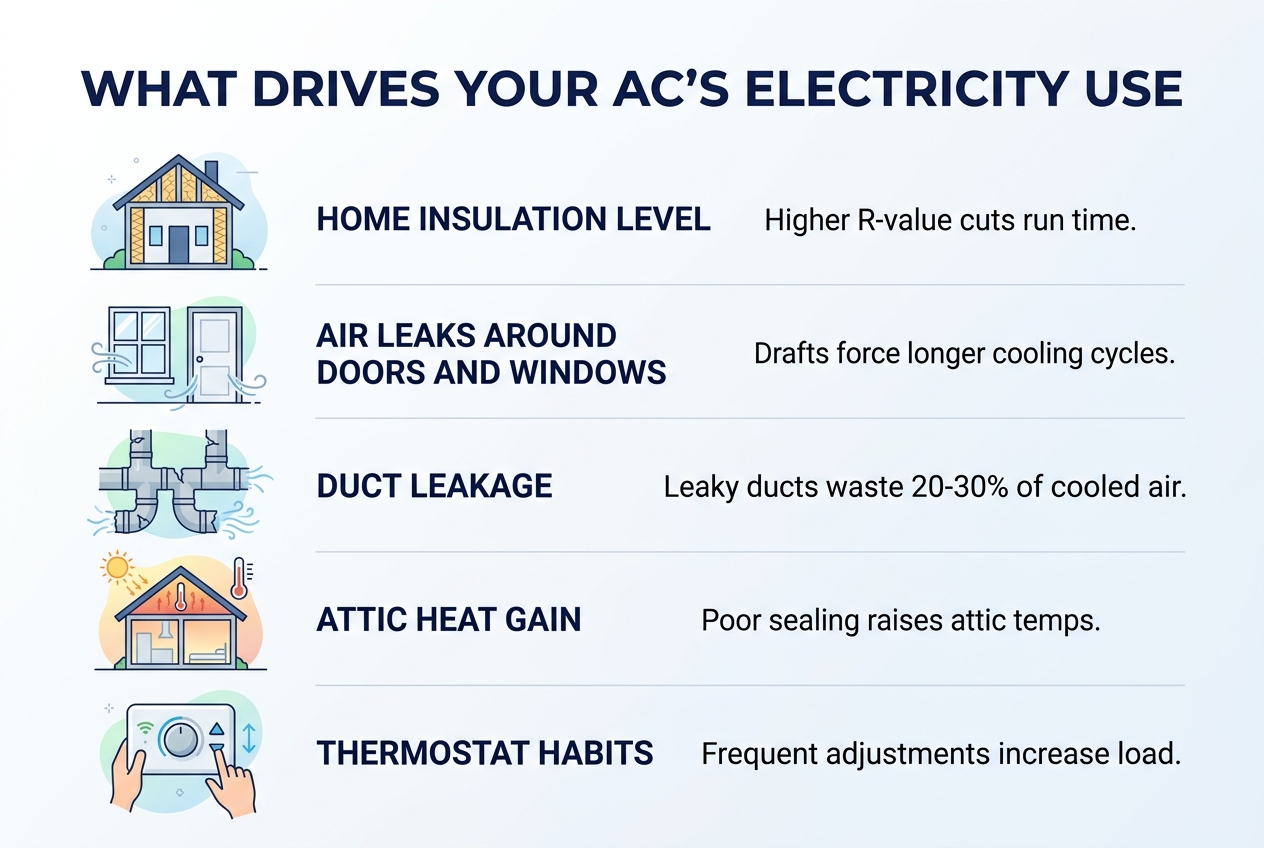
Your cooling bill isn’t just about the unit outside. System type and SEER rating matter, sure, but so do square footage, insulation R-value, duct condition, air leakage, thermostat habits, and your local climate. All of it stacks together. An oversized unit cools the room fast, then shuts off before it pulls humidity out, so it cycles on and off all afternoon wasting electricity. An undersized one just runs forever, straining to catch up. Either way, a fat SEER number on the box doesn’t save you if the sizing was wrong from day one.
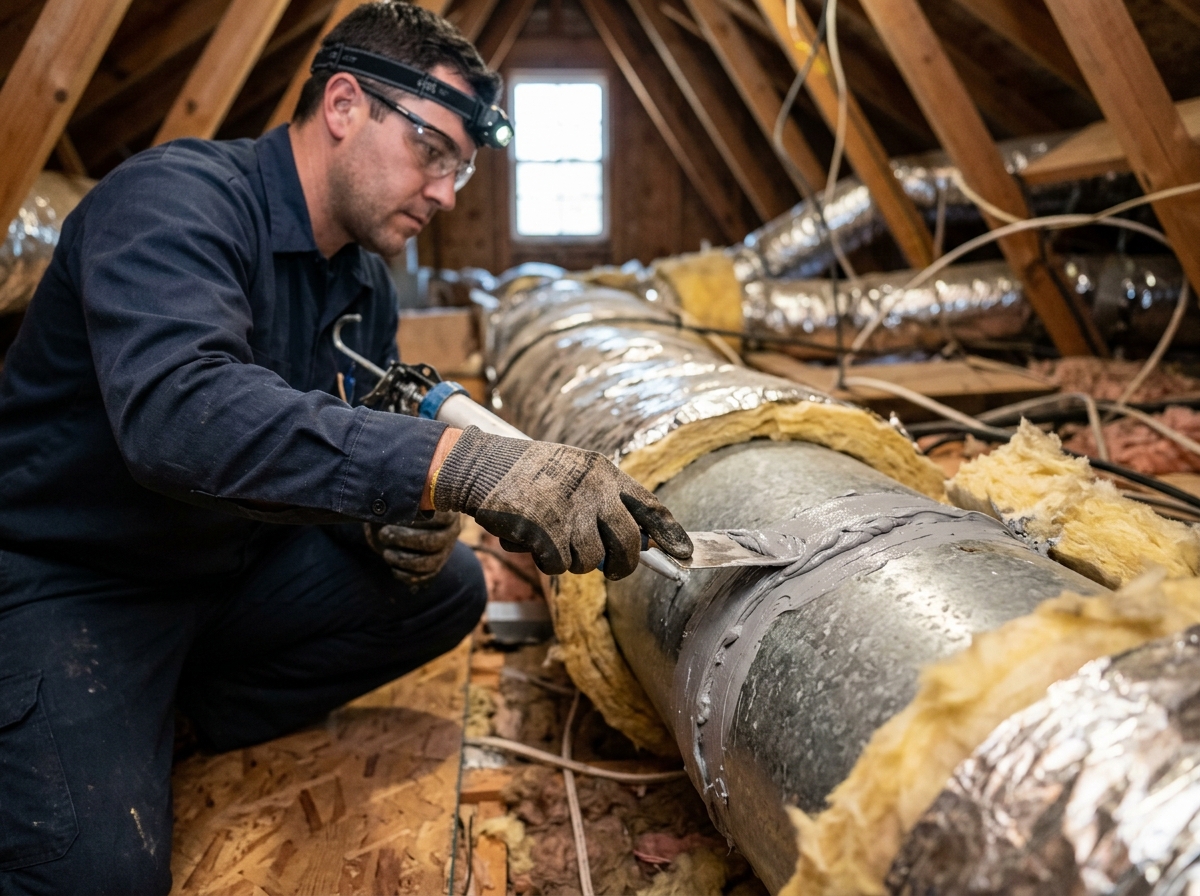
Then there’s the ductwork, and this is where most homeowners get blindsided. Ducts running through a hot attic can lose 20-30% of cooled air before it ever reaches a bedroom or living room. That’s air you paid to cool, dumped straight into 130-degree attic space. If a system seems to be struggling and rooms never quite hit temperature, it’s worth ruling out duct leakage before assuming the equipment itself is failing — that kind of equipment diagnosis and any repair or replacement work belongs to a licensed HVAC contractor. Sealing existing ducts with mastic or aerosolized sealant, verified with pre- and post-test pressure readings, is a different job entirely, and it often recovers a big chunk of that lost air without touching the equipment at all.
How insulation levels change the equation
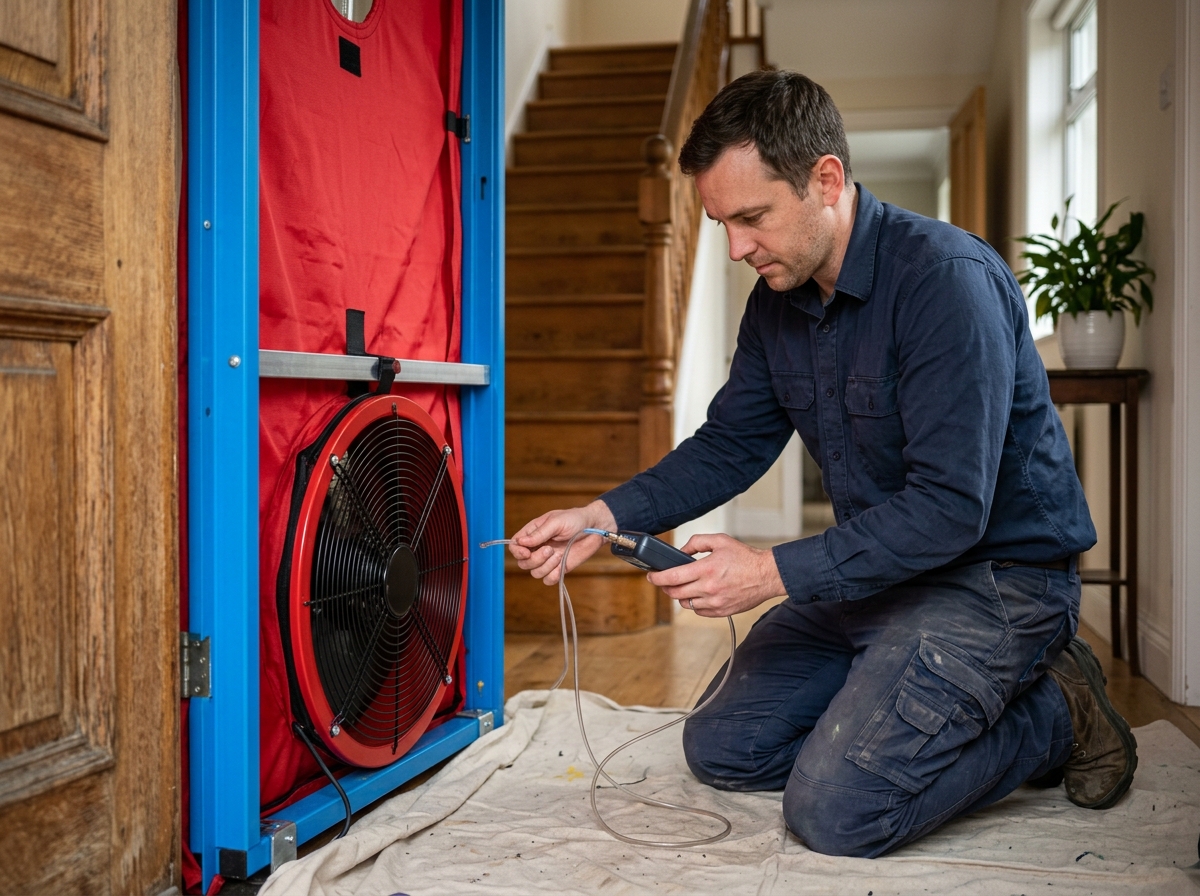
Leakage isn’t only about ducts. Gaps around top plates, rim joists, recessed lighting, and attic penetrations let conditioned air escape and let outdoor heat pour back in, all day, every day. A home energy assessment with a blower door test can pinpoint exactly where that’s happening, since guessing rarely works. Air sealing closes those specific gaps before any insulation goes in, which matters, because insulation over unsealed leaks is like putting on a coat with the zipper open.
Insulation level is the other half of the equation. An attic sitting at R-13 when it should be at R-38 or higher is bleeding conditioned air through the ceiling, forcing the AC to fight a losing battle. Blown-in cellulose fills irregular joist bays and settles around wiring and framing in ways batts simply can’t match, reaching up to R-60 with depth and R-value checked after installation. For anyone researching how attic heat gain actually works, reviewing how sealed ductwork affects cooling efficiency is a useful next step before deciding whether ducts, insulation, or both are the real culprit. Skip the diagnosis, and you’re just guessing where the money’s going.
Electricity Use and Monthly Cost by AC Type
Not all AC systems pull power the same way. Some cool a whole house for less than you’d think. Others quietly drain your bill while barely touching one room. The table below lays out typical wattage, monthly kWh, and estimated cost at a national average rate of about $0.16 per kWh, assuming 8 hours of daily run time.
| AC Type | Typical Wattage | Est. Monthly kWh | Est. Monthly Cost |
|---|---|---|---|
| Central AC (3-ton) | ~3,500W | 840 kWh | $134 |
| Window unit (small-large) | 500–1,500W | 120–360 kWh | $19–$58 |
| Portable AC | 1,200–2,900W | 288–696 kWh | $46–$111 |
| Ductless mini-split | 700–2,000W | 168–480 kWh | $27–$77 |
Central air costs the most in raw dollars, but it’s cooling every room, not just one. Window units win on single-room budgets, though bigger models creep close to central AC territory. Portable units are the least efficient of the bunch. They’re pulling similar wattage to a small central system but only cooling one space, and their duct hose setup loses cool air fast. Mini-splits do the best per watt, mostly because there’s no ductwork to leak air along the way. That gap matters more than most homeowners realize; understanding why your electricity bill runs high often comes down to duct losses, not the equipment itself. A well-sealed home can shrink any of these numbers, which is really the point of comparing them at all.
How to Estimate Your Own AC’s Electricity Use
You don’t need an engineering degree to figure out what your AC is costing you. There are three practical routes: dig through past bills, compare your home to similar-sized ones nearby, or run the math yourself using your unit’s nameplate wattage and how many hours it actually runs. Each method gets you closer to a real number instead of a guess.
Step-by-step wattage calculation
The nameplate on your outdoor unit lists its wattage draw. From there, the formula is simple: wattage × hours run per day × 30 days ÷ 1000 = monthly kWh, then multiply by your utility’s per-kWh rate. A 3,500-watt central AC running 7 hours a day comes to roughly 735 kWh a month. Understanding the cost of electricity in louisiana helps you turn that kWh figure into an actual dollar amount worth comparing against your bill.
| Method | What You Need | Accuracy | Best For |
|---|---|---|---|
| Past bill review | 12 months of statements | Moderate | Spotting seasonal trends |
| Neighbor/home comparison | Square footage, home age | Low | Quick gut-check |
| Nameplate wattage calc | Unit label, runtime estimate | Moderate-High | DIY budgeting |
| Blower-door measured baseline | Professional equipment | High | Real leakage numbers |
Reading your utility bill for cooling-season patterns
Line up your kWh usage month to month, especially May through September. A jump that outpaces the temperature swing usually points to leakage, not just heat. This is where before-and-after comparisons earn their keep: if air sealing or duct sealing happened in June, July’s bill should show it. No spike, no drop — that’s a red flag worth digging into.
Math and bill-reading only get you so far, though. A home energy assessment with blower-door and duct blaster testing swaps your estimate for a measured baseline, showing exactly where conditioned air is escaping. For questions about scheduling one, the contacts page has the details. That number becomes your yardstick for every improvement after it.
Signs Your Home Is Wasting AC Electricity
Your AC hums along all day, and yet something still feels off. Some rooms stay warm. Bills creep up for no clear reason. These aren’t random quirks — they’re usually symptoms of air leaking out and heat sneaking in, and your cooling system paying the price. Catching these signs early saves you money before the problem gets worse.
- Rooms that never reach the thermostat setting no matter how long the system runs, which usually points to duct leaks starving that room of cold air.
- Noticeable temperature swings between rooms or between floors, with upstairs bedrooms baking while the living room stays comfortable.
- Musty odors, dust buildup, or pollen tracking indoors, a sign that gaps in ductwork or the building envelope are pulling in attic or crawlspace air.
- Bills that run noticeably higher than a neighbor’s similar-sized home, even when your thermostat habits are about the same.
- An attic hatch, interior wall, or supply vent that feels hot to the touch on a summer afternoon, which means conditioned air is losing ground fast.
None of these are things you just live with. A properly done benefits of insulating your attic conversation often starts right here, once someone notices the hatch feels hotter than the hallway. Uneven cooling and odd bills aren’t quirks of an old house — they’re data points. And if your numbers look out of line with what similar homes use, it’s worth checking How much electricity is used for air conditioning in the … for a sense of what’s typical before assuming your system is just old or undersized.
Reducing AC Electricity Usage Without Replacing Equipment
Before you call anyone about a new unit, look at what’s letting cool air escape in the first place. A leaky house makes any AC work harder, no matter how new or efficient it is. Most electricity waste isn’t in the equipment. It’s in the gaps around it.
Where air sealing makes the biggest difference
Conditioned air doesn’t just drift out the front door. It sneaks out through dozens of small openings you’d never think to check. Air sealing targets those spots directly, and the difference shows up fast on a blower-door test. Reviewing air sealing project results makes clear how much leakage hides in ordinary framing details.
- Cracks and gaps in exterior walls, floors, and ceilings that let outside heat seep into living spaces all day long
- Attic penetrations around plumbing stacks, wiring chases, and HVAC lines that act like open funnels for hot air
- Top plates where walls meet the attic, a spot builders routinely leave unsealed
- Recessed light housings that create direct pathways between conditioned rooms and blazing-hot attic space
- Rim joists around the foundation, often the single leakiest spot in an older home
Seal those and your AC stops fighting a losing battle. That alone can drop cooling demand noticeably.
Why duct sealing often outperforms duct replacement for cost
Ductwork loses cool air before it ever reaches a room, sometimes 20-30% of it. Sealing existing ducts with brush-on mastic or aerosolized sealant closes those leaks from the inside out, verified with pre- and post-test flow pressure measurements that prove the fix worked. That’s a fraction of the cost of tearing out and replacing entire duct runs — and full duct replacement or new ductwork design is a separate job for a ductwork specialist, not something this approach tries to duplicate. Blown-in cellulose insulation, installed to R-38 or higher and sometimes up to R-60, then cuts the heat transfer coming through attics and walls, which is a different but related fight than duct leakage. Dense-pack cellulose also fills irregular cavities and settles around wiring and framing in ways that leave fewer gaps than batts. After a home gets tightened up this much, combustion-safety checks confirm that water heaters and furnaces are still drafting safely, since a sealed house behaves differently around combustion appliances. None of this replaces your AC. It just means the unit you already own doesn’t have to work as hard, and for actual repairs, tune-ups, or a full system swap, that job belongs to a licensed HVAC contractor. Comparing your own numbers against typical Electricity usage of a Central Air Conditioner can show whether tightening the building envelope is closing the gap before you spend on equipment at all.
Getting a Clear Picture Before You Spend Money
What a BPI-certified assessment actually measures
Before you spend a dime chasing your AC’s power draw down, you need to know where the waste actually lives. A proper assessment runs a blower door test to measure how much air your house leaks, a duct blaster test to check what’s escaping through the ductwork, thermal imaging to spot heat gain, and an attic R-value check to see if your insulation is even close to adequate. Together these energy assessments turn guesswork into numbers.
Thermal imaging in particular tells you something a visual attic inspection can’t: whether hot spots are from missing insulation, or from air leaking in around top plates and recessed lights. That distinction matters. It decides whether the fix is air sealing, blown-in cellulose, or both. Guessing wrong means paying twice.
The real payoff is a written, prioritized plan instead of a pile of random fixes. You’ll know what to do first, what it should cost, and what savings to expect. That documentation is what separates a real energy plan from a shot in the dark.
How utility programs reduce upfront cost
Here’s the part homeowners don’t expect: this work often costs little to nothing out of pocket. Programs through Entergy, CLECO, Mississippi Power, Atmos Energy, and Energy Smart frequently cover most or all of the assessment and weatherization work, with free service for income-eligible households. That’s not a discount gimmick — it’s utilities paying to reduce peak demand, and homeowners riding along for the benefit.
The catch, if you can call it that, is the paperwork. Rebate forms and utility incentive applications are tedious, and plenty of people give up halfway through. Having someone handle that paperwork on your behalf removes the one barrier that stops most people from starting at all. You just get the assessment, get the plan, and let someone else chase the forms.
Worth saying plainly: skipping the assessment to save time usually costs more later. Sealing ducts or blowing in insulation without knowing the actual leakage numbers is a coin flip, not a plan.
Frequently Asked Questions About AC Electricity Usage
A few myths about cooling costs refuse to die. Let’s clear them up, one at a time, with straight answers you can actually use.
- Does closing vents in unused rooms save electricity? Usually not — most systems are balanced for a set airflow, and blocking vents raises duct pressure, strains the blower motor, and can push conditioned air out through leaks instead of into the rooms you actually use.
- Is a bigger AC unit always more efficient? No — an oversized unit cools the air fast, shuts off, then restarts constantly, a pattern called short cycling that wastes electricity and leaves humidity high and rooms feeling clammy.
- How much can air sealing and insulation realistically lower a cooling bill? Homeowners often notice a difference within one billing cycle when sealing is paired with duct repairs, since both attack the same leakage that forces the system to run longer than it should.
- Will tightening a home create ventilation problems? Sometimes, which is why a proper assessment checks fresh-air needs against ASHRAE 62.2 guidelines before any sealing work begins, rather than tightening a house blind. Installing any fans, ERVs, or HRVs that turn out to be needed is a job for a ventilation specialist.
- Should moisture or pest issues be fixed before insulation work? Yes, always — damp wood or an active infestation ruins insulation performance fast, so a waterproofing contractor or pest professional needs to resolve those first, before any attic or wall cavity gets filled.
- Does duct sealing replace the need for new ductwork? Often, yes — pre- and post-test pressure readings frequently show that sealing existing runs recovers most of the lost airflow, which can delay or avoid a costly replacement altogether.
Notice a pattern? Almost every one of these questions traces back to airflow, pressure, and how tightly a house is built. That’s really what drives electricity use more than the thermostat setting ever does. Getting straight answers before you spend money on equipment or upgrades is the whole point of an honest assessment.
Before deciding, it helps to think about what’s actually causing the discomfort or high bills in the first place, since drafty doors and uneven rooms often trace back to air leaks and thin insulation rather than the windows or vents homeowners tend to blame. It’s worth asking for real numbers, before-and-after blower-door or thermal imaging results, rather than taking someone’s word that a job improved efficiency. And since so much comes down to trust, pay attention to how clearly a contractor will talk you through the findings and text you a straight answer when you have questions.
