


You did your homework. You picked out the most energy efficient air conditioner on the lot, installed it, and waited for your bills to drop. They didn’t move much. Here’s the problem: a high-efficiency unit cooling a leaky, under-insulated house is still fighting a losing battle. This guide walks you through why the equipment is only half the job, and what actually closes the gap between rated efficiency and real savings.
Why an energy efficient air conditioner alone won’t fix a high utility bill
How air and duct leakage cancel out equipment efficiency gains
A brand-new high-SEER unit doesn’t operate in a vacuum. It still has to push cooled air through the same ductwork that’s been leaking into your attic for fifteen years. If 20-30% of that air escapes before it reaches a single vent, you’ve paid a premium for efficiency the ducts just throw away. The equipment can only be as good as the delivery system attached to it.
Same goes for the house itself. Gaps around top plates, rim joists, and recessed lighting let cooled air drift out and hot, humid air drift in all day long. Your new unit just runs longer chasing a losing battle. That’s wasted electricity, plain and simple.
Correct sizing matters, but only if the air actually arrives. A unit sized perfectly for a 1,800-square-foot home can still leave the back bedroom at 78 degrees if the duct run feeding it has a disconnected joint in the attic. Capacity on paper means nothing without delivery in practice.
How air and duct leakage cancel out equipment efficiency gains
Louisiana and Mississippi summers add a wrinkle most homeowners underestimate: humidity. It’s not just heat you’re fighting. Leaky envelopes pull in moisture-laden outside air constantly, forcing the AC to work overtime wringing water out of the air before it can even cool it. That’s a double load on equipment designed to handle just one job well.
This is why two identical homes with identical units can have wildly different comfort and bills. One’s tight, one’s leaky. Humidity sneaking through a leaky envelope also explains those musty odors and sticky rooms that never quite feel cool, even when the thermostat says 72. If you’ve ever wondered why your electricity bill is too high every July despite a newer unit, envelope leakage is usually the overlooked culprit, not the equipment itself.
That’s the real argument of this guide: buy a smart, properly sized unit, yes. But seal the ducts and the envelope first, or at least alongside the purchase. Skip that step, and you’re financing someone else’s attic.
ENERGY STAR ratings, SEER2 numbers, and what they actually measure
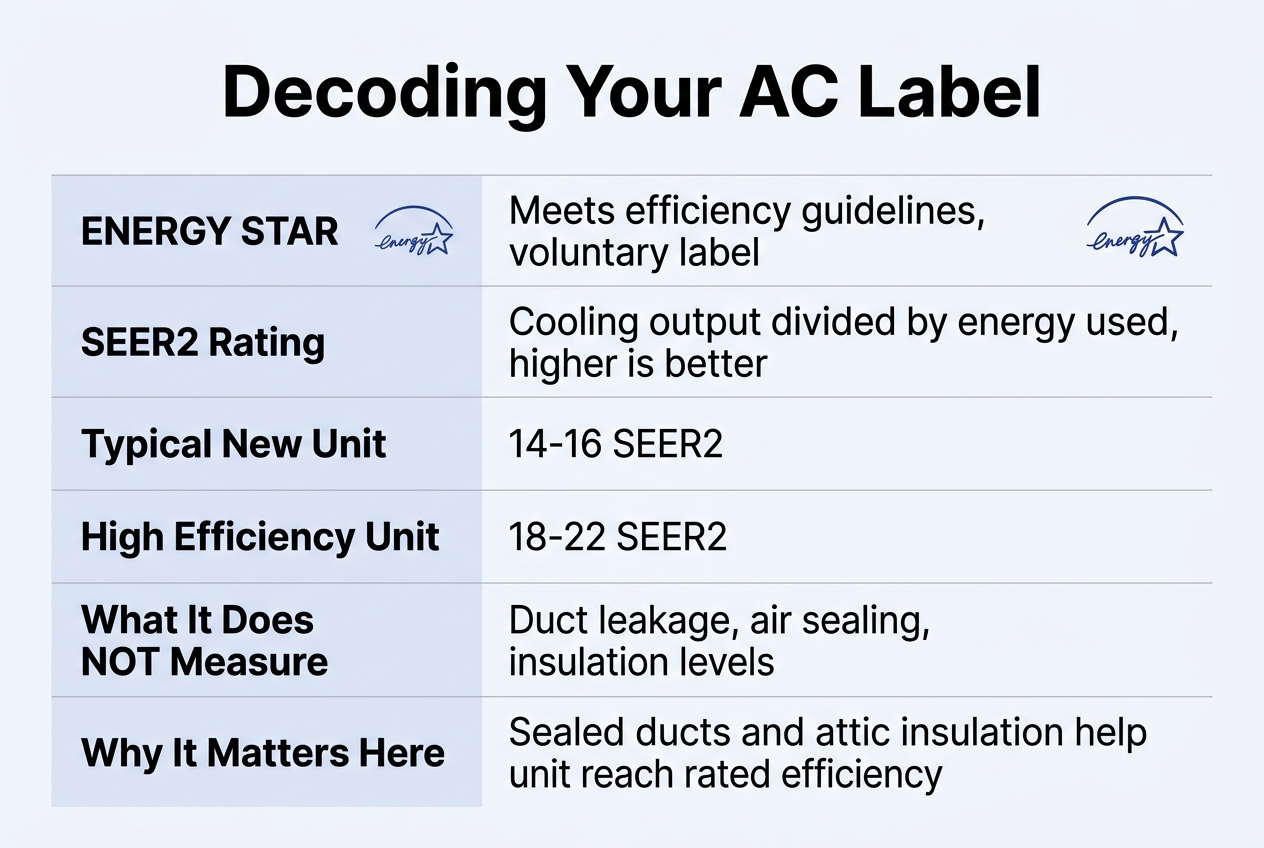
ENERGY STAR certification is the baseline: a unit has to clear a minimum efficiency bar set by the EPA to wear the label at all. The “Most Efficient 2026” distinction sits above that, reserved for the top slice of models that beat the baseline by a wide margin. Neither label tells you what your actual bill will look like. That depends on the number underneath it, and there are three different ones depending on what you’re buying.
SEER2 vs EER2 vs CEER: which number matters for which unit type
SEER2 measures seasonal cooling efficiency for central systems under updated test conditions that better reflect real ductwork and static pressure. EER2 looks at efficiency at one specific peak outdoor temperature, which matters more for ductless mini-splits and heat pumps running hard on the hottest day. CEER, or Combined Energy Efficiency Ratio, is the number you’ll see on room and window units, factoring in standby power draw. Here’s how they break down in plain terms.
| Metric | Unit type | What it measures | Good number to look for |
|---|---|---|---|
| SEER2 | Central split systems | Seasonal average efficiency | 15.2+ (16+ for top tier) |
| EER2 | Ductless mini-splits, heat pumps | Peak-heat performance | 12+ |
| CEER | Window and room units | Combined efficiency plus standby draw | 12+ |
| HSPF2 | Heat pumps (heating mode) | Seasonal heating efficiency | 7.8+ |
Here’s the catch nobody puts on the spec sheet: a high SEER2 number assumes the ductwork and house around the unit are tight. In a leaky home, a lot of that rated efficiency just leaks out through gaps and poorly sealed returns before it ever reaches a room. Anyone comparing equipment brands, including research pulled from an AC installation guide, will find the same caveat buried in the fine print: lab numbers assume lab conditions. Your attic isn’t a lab.
This matters for your wallet beyond the bill, too. Most utility rebate programs, including the ones referenced by regional providers, set their qualifying thresholds directly off SEER2, EER2, or CEER figures. Falling short of the listed number by even a fraction can mean losing the rebate entirely. Before shopping specs, it’s worth understanding what energy assessments reveal about your home’s baseline, since that number shapes whether a high-efficiency unit can actually perform to its rating once installed.
Sizing and buying guidance: picking the right unit for the right space
Central vs ductless vs room units: matching the system to the home
Picking a system starts with the space, not the brochure. A central system makes sense when ducts already reach every room and are in decent shape. A ductless mini-split earns its keep in additions, converted garages, or homes where running new ductwork isn’t practical. Room units, window or portable, are the budget fix for a single problem room. None of these choices matter much, though, if the home around the equipment is leaky. Sizing follows a simple sequence, and skipping steps is where most buyers go wrong.
- Step 1: measure the length and width of the room or zone to get total square footage, including any vaulted or open areas that share the same airspace.
- Step 2: match that square footage to a BTU figure using a standard sizing chart, which generally runs around 20 BTUs per square foot for average rooms.
- Step 3: adjust the number up for high ceilings, west-facing windows, hot climates, and rooms with more than two regular occupants.
- Adjust the number down for heavy shade, good existing insulation, or rooms that stay mostly closed off during the day.
- Consider variable-speed, inverter-driven units for homes with uneven cooling needs, since they throttle output instead of cycling fully on and off.
- Use smart or connected thermostats to track runtime and catch a unit that’s cycling too often, a classic sign of oversizing.
Worth noting: a home’s real cooling load often shrinks once gaps and ducts get sealed, so sizing a replacement unit before that work is done can lock in an oversized system for years. Reviewing the benefits of insulating your attic first will usually change the BTU math.
Common oversizing mistakes that waste energy and money
Bigger isn’t better here. An oversized unit cools the air fast, shuts off, then starts again soon after, a pattern called short-cycling. That means it never runs long enough to pull humidity out of the air. The room feels cold and clammy at the same time. It’s a strange, uncomfortable combination, and it’s completely avoidable with correct sizing. Oversizing also strains compressors with constant starts and stops, shortening the unit’s working life.
Retrofit situations deserve their own note. U-shaped and saddle-style window units slide over the sill rather than blocking it, which keeps more daylight and lets you still open part of the window. Standard units remain the simplest option for single rooms with no special sill shape. Whichever style you pick, match the BTU rating to the room, not the wall opening. If you have questions about matching assessment findings to a sizing decision, reaching out through the contacts page is a reasonable first step before buying anything.

The hidden reason new efficient units underperform: duct and envelope leakage
What a blower-door and duct-blaster test actually reports
Here’s the number that surprises most homeowners: the average duct system loses around 20-30% of conditioned air before it ever reaches a register, according to long-standing industry figures from building science research. Add in attic bypasses, gaps around top plates, and leaky rim joists, and a poorly sealed envelope can waste 40% or more of what your system produces. A brand-new unit doesn’t fix any of that. It just pumps expensive air into the same leaky box.
That’s why a room at the far end of the house never quite hits the thermostat setting, even with a top-tier compressor running outside. The air handler is doing its job. It’s the path between the unit and that room, ductwork, boots, returns, where the cooling or heating disappears. A homeowner notices the symptom, blames the equipment, and upgrades it. The leak stays exactly where it was.
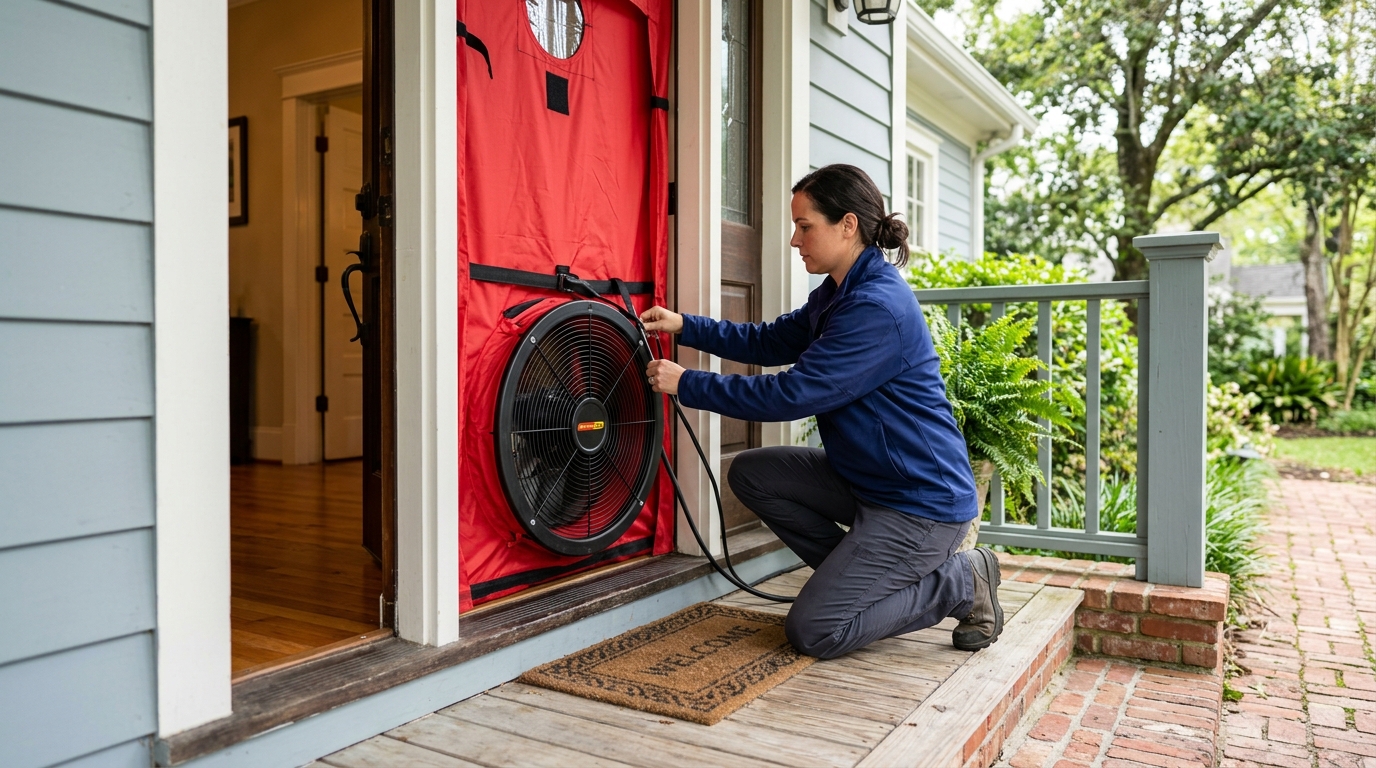
A proper assessment doesn’t guess at any of this. A blower door depressurizes the whole house and measures air changes per hour, giving you a hard leakage number instead of a hunch. A duct blaster does the same thing just for the duct system, isolating how much air escapes before delivery. Reviewing duct sealing results from similar homes shows how much of that lost volume is typically recoverable once leaks are mechanically repaired.
Thermal imaging and attic R-value checks reveal where the new unit’s output is being wasted
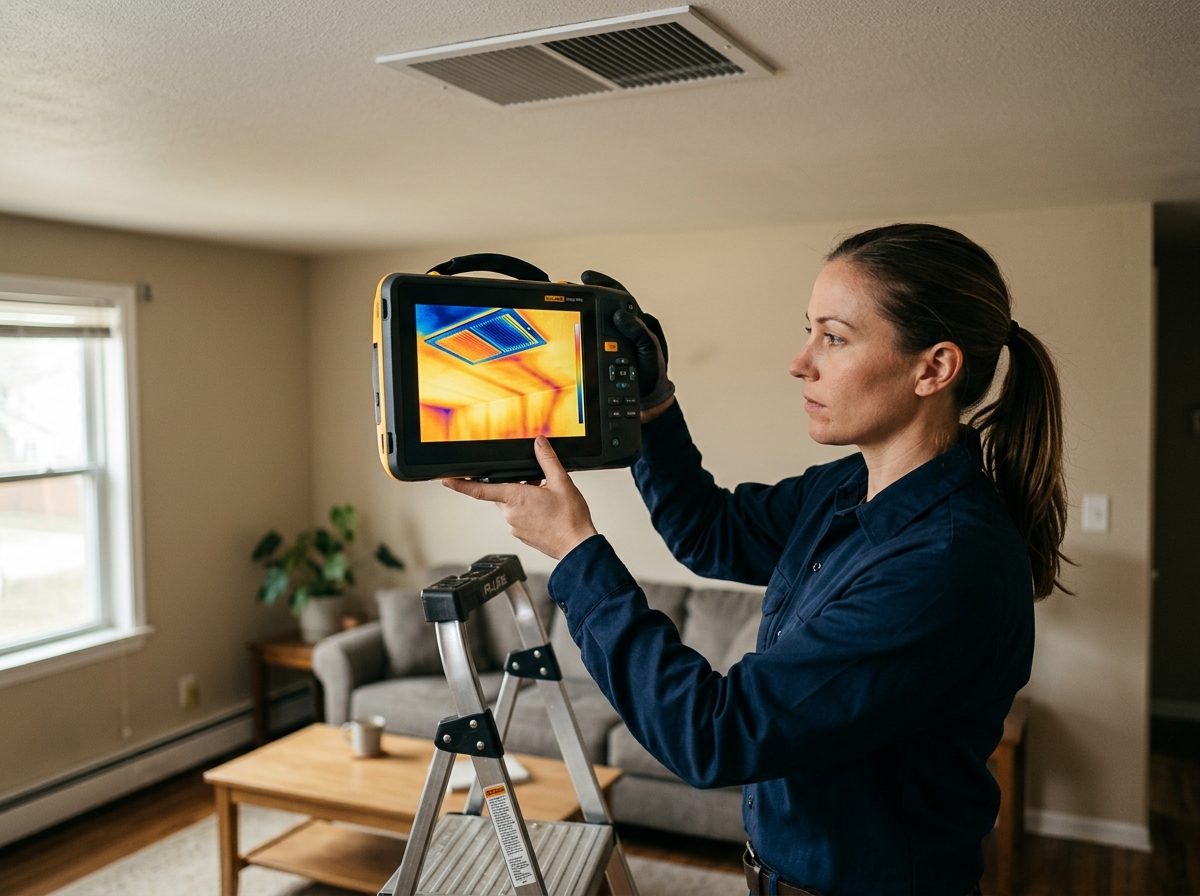
Numbers tell you how much air is missing. Thermal imaging shows you exactly where it’s going. An infrared scan during the assessment picks up cold or hot streaks around can lights, attic hatches, and wall cavities, the spots where conditioned air is quietly bleeding out. Pair that with an attic R-value check, and you’ll often find insulation sitting at R-19 or lower in a climate that calls for R-38 or higher. That gap alone can account for a shocking share of a new unit’s wasted output.
Browsing a portfolio of completed jobs makes the pattern obvious: the homes with the biggest comfort complaints almost always show the same combination of duct leakage plus under-insulated attics, not a failing compressor. Fix the diagnosis before you fix the symptom. That’s the whole point of testing first.
Sealing and insulating before you upgrade: the lower-cost path to the same comfort goal
Before you spend thousands on a new condenser, think about what that unit actually has to fight against. Air leaking through top-plates, recessed lights, and rim joists forces the system to cool outside air you’re paying for twice. Air sealing closes those gaps first, which lowers the load any AC has to handle, old or new. Duct sealing with brush-on mastic or aerosolized sealant does something similar from the inside, recovering airflow that’s been leaking into attics and crawlspaces without tearing out a single run of ductwork.
Why dense-pack cellulose outperforms batts in real-world attics
Attics are never the tidy rectangles batts assume they are. Wiring, framing, and odd joist spacing leave gaps that pre-cut batts simply skip. Blown-in cellulose, installed dense-pack up to R-60, flows around obstructions and settles into irregular cavities in a way batts can’t match. Depth and R-value get verified after install, not guessed at. Here’s a quick side-by-side:
| Factor | Fiberglass batts | Dense-pack blown cellulose |
|---|---|---|
| Fit around obstructions | Leaves gaps at wiring, joists | Flows around and fills voids |
| Max practical R-value | Typically R-30 to R-38 | Up to R-60 |
| Settling verification | Rarely measured post-install | Depth/R-value checked after blow |
| Air leakage impact | Minimal, batts don’t seal air | Paired with air sealing for real reduction |
| Utility rebate eligibility | Inconsistent | Often fully eligible |
Where air sealing replaces the need for spray foam or radiant barrier claims
Spray foam and radiant barrier products get pitched hard, but those are jobs for other contractors, not something you’ll find here. A home energy assessment with thermal imaging and an attic R-value check usually shows cheaper fixes solve the same heat problem. Sealing plus cellulose costs far less than foam, and it qualifies for incentives that foam and foil products rarely touch. Once a home gets tightened, combustion safety checks confirm water heaters and furnaces still draft properly. That step matters. Skip it, and a tighter house can backdraft a gas appliance without anyone noticing until it’s a problem. If you’re weighing a new AC quote against envelope work, it helps to first understand the cost of electricity in Louisiana and how much of your bill leakage is actually responsible for. A full rundown of what’s involved is on our services page.
Rebates and incentive programs: stacking savings with the right partner
Utility programs through Entergy, CLECO, Mississippi Power, Atmos Energy, and Energy Smart often cover assessment and weatherization work at little to no cost. That’s not a typo. Many homeowners pay nothing, or close to it, for a full home energy assessment plus follow-up sealing and insulation. Income-eligible customers may qualify for completely free service, which is a separate track from any manufacturer rebate tied to buying a new AC unit. The two aren’t the same program, and confusing them is a common reason people miss out on one or both.
Which documentation utility programs typically require
Here’s the part nobody warns you about: paperwork is where most savings quietly die. Deadlines slip. Forms get filed wrong. A missing signature or a skipped test result can bounce a claim back weeks later, long after the motivation to fix it has faded. Utility programs tend to ask for specific proof, not just a receipt, and that proof usually has to come from diagnostic testing performed before and after the work. Knowing what’s expected ahead of time saves a second trip and a second headache. Typical requirements include:
- A pre-work blower-door test establishing the home’s baseline air leakage rate in cubic feet per minute, used to prove how much tightening actually occurred.
- A post-work blower-door retest showing the percentage reduction in leakage, which many programs treat as the core evidence for a weatherization rebate claim.
- Duct blaster readings taken before and after duct sealing, documenting airflow loss recovered in the supply and return system.
- Itemized invoices separating labor, materials, and equipment costs, since some rebates apply only to specific line items.
- Proof of income eligibility for customers applying through a free-service track, kept separate from standard rebate submissions.
- Manufacturer model and efficiency documentation for any new AC unit, filed independently from the weatherization paperwork tied to sealing and insulation.
Having someone handle the rebate and incentive paperwork on your behalf removes the single most common reason homeowners skip applying altogether: it’s tedious, and tedium kills follow-through. A properly documented pre/post blower-door and duct blaster report is typically the evidence utilities actually want, not a summary or a guess. If you’re buying new equipment on top of weatherization work, reviewing guidance on purchasing efficient central air conditioners alongside your weatherization paperwork helps keep both rebate tracks moving without one holding up the other. Diagnostic-backed claims, like those built around air sealing performed under BPI protocols, tend to move through review faster simply because the numbers are already there.
Finding an energy efficient air conditioner setup: a practical action plan
Step one: measure before you shop
Don’t walk into a showroom until you have numbers. A home energy assessment gives you a blower-door reading for total air leakage, a duct blaster test for how much conditioned air escapes before it ever reaches a vent, and an attic R-value check showing what insulation you actually have versus what you need. These three data points turn equipment shopping from a guess into a calculation.
Most homeowners have never seen their own leakage numbers. That’s the problem. You can’t size a unit correctly, or know if your current one is overworked, without a baseline. Thermal imaging adds another layer, flagging cold or hot spots in walls and ceilings that explain why certain rooms never feel right. Keep these results; they drive every decision that follows.
Let the numbers decide if you need a smaller unit
Once you know where air is escaping, you can ask a sharper question: would sealing and insulating let a smaller, cheaper unit handle the same space? Often, yes. Dense-pack blown-in cellulose fills irregular attic and wall cavities more completely than batts, settling around wiring, boxes, and framing where gaps usually hide, and it’s verified afterward for depth and R-value up to R-60.
Duct sealing matters just as much here. Mastic or aerosolized sealant closes leaks in existing ductwork, and pre- and post-test flow pressure readings show exactly how much leakage got recovered before you spend a dollar on new equipment. A leaky, under-insulated house pushes buyers toward oversized units that short-cycle and wear out fast. Tighten the envelope first, and the math on equipment size often changes entirely.
Bring in a licensed HVAC contractor, but only after sealing
With tighter ducts and a properly insulated attic, it’s time to get sizing quotes from a licensed HVAC contractor who follows Manual D standards. This step is strictly for equipment: sizing, repair, or replacement decisions belong to them, not to a weatherization provider. Give them your post-weatherization numbers, not pre-sealing estimates, or you risk buying a unit sized for a leakier house than the one you actually have.
A contractor working from accurate load numbers can often spec a smaller-tonnage system, which costs less upfront and less to run every month. That’s the whole point of doing things in order. Skip the sealing step and you’ll likely get a bigger, pricier unit recommended to compensate for losses that didn’t need to exist.
Schedule the diagnostic work with a certified Building Analyst
Accurate numbers depend on who’s taking them. A BPI-certified Building Analyst Professional runs the blower-door test, duct blaster test, and combustion-safety check using standardized protocols, so your before-and-after comparisons actually mean something. Combustion safety checks matter especially once a home gets sealed tighter, since water heaters and furnaces need to draft properly or backdrafting becomes a real risk.
This diagnostic approach, paired with air sealing of attic penetrations, rim joists, and top-plates, is also where readers researching the topic tend to dig deeper; the blog covers specifics on what shows up in these inspections and why certification matters for the results. Reviews on jobs like this tend to mention the same things: efficiency gains, careful work around doors, and job quality that holds up on a retest.
File the verification report and don’t lose it
After the work’s done, you should get a post-test verification report comparing before-and-after blower-door and duct blaster numbers. Keep it. It proves the leakage reduction actually happened, not just that someone showed up and did work.
That report pulls double duty. Use it to track comfort and bills over time, and keep it on hand for future rebate applications or as documentation during a home sale, when buyers increasingly ask about efficiency upgrades. Rebate paperwork gets handled on your behalf through utility programs, which removes one more hassle from a process that’s already got enough moving parts.
Before committing to any fix, it helps to ask what’s actually driving the discomfort or the high bills — is it truly the equipment or windows getting blamed, or is air leaking through gaps most people never think to check? A blower-door number and a thermal image often tell a more honest story than a guess, and that clarity is worth more than jumping straight to a big-ticket replacement. Whatever path a homeowner chooses, it’s worth talking it through and getting the efficiency numbers in hand first, so the next dollar spent actually solves the problem.
