


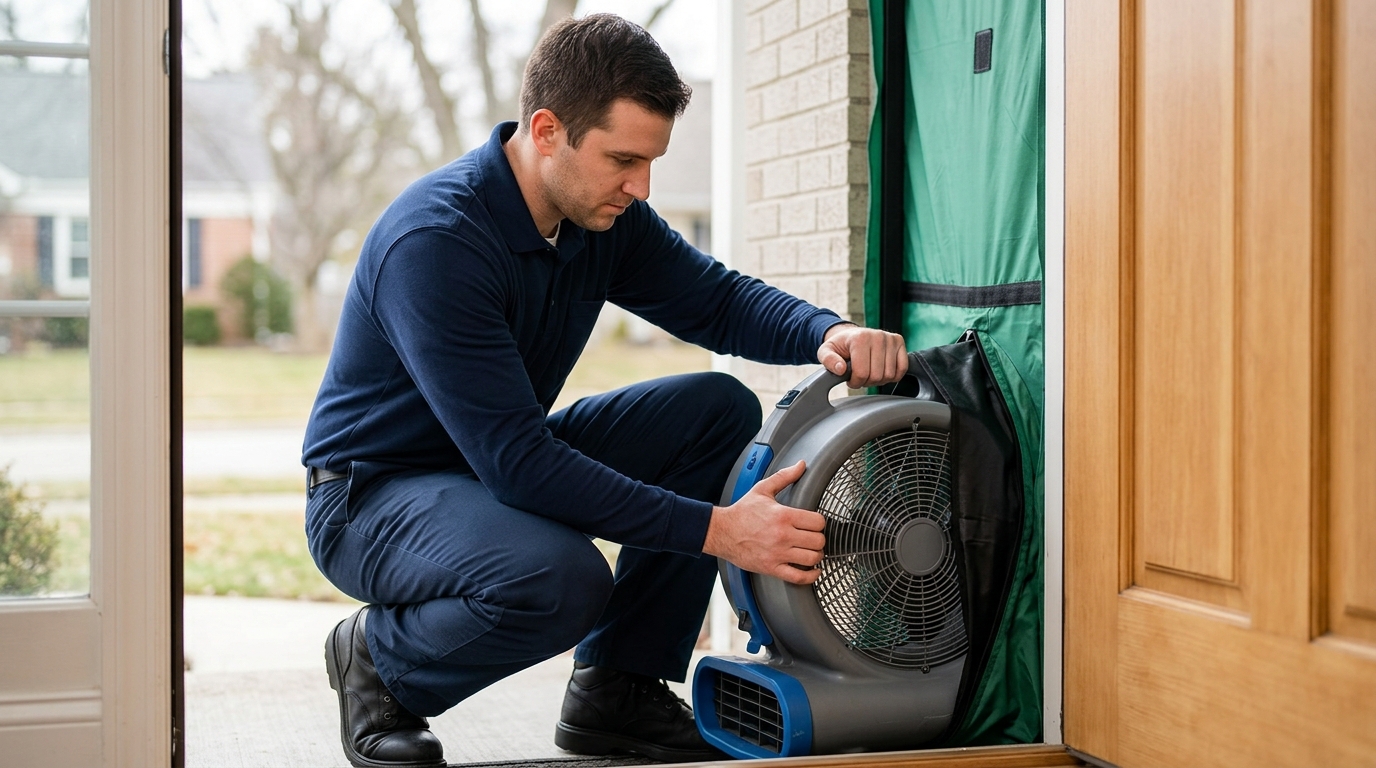
Your old chest freezer runs almost nonstop, and your electric bill shows it. Choosing an energy efficient chest freezer in 2026 means wading through star ratings, door styles, and compressor specs that all claim to save you money. We’ll walk you through what actually matters before you buy, so you pick a model that earns its keep. One note: freezer shopping is just one piece of a truly efficient home.
Why an Energy Efficient Chest Freezer Matters for Your Power Bill
How Appliance Efficiency Fits Into Whole-Home Energy Use
A chest freezer doesn’t take a day off. It runs 24 hours a day, 365 days a year, for a decade or more. That constant cycle is exactly why small efficiency differences stop being small. A unit that draws even 50 extra watts on average will quietly rack up real dollars every billing cycle, year after year, long after you’ve forgotten the price tag on the box.
ENERGY STAR certified chest freezers typically use about 10 to 20 percent less energy than standard models with similar capacity. On paper that sounds modest. Multiply it across 8,760 hours a year, though, and it adds up to a noticeable chunk of your freezer’s lifetime operating cost — often more than the price difference between models at the store.
But a freezer is just one appliance in a much bigger system. If you’ve ever wondered why your bills spike despite buying “efficient” appliances, the answer is often elsewhere in the house, and understanding why your electricity bill is too high usually means looking past the appliance aisle entirely. Air leakage, duct losses, and thin attic insulation can waste far more energy than any single freezer ever will. That’s the honest truth most buying guides skip.
This is where the bigger picture matters. A freezer sitting in a hot, leaky garage works harder than one in a conditioned, well-sealed space, no matter how good its compressor is. Pairing a genuinely efficient model with a tighter building envelope — sealed air leaks, a properly insulated attic, sealed ductwork — doesn’t just add the savings together. It multiplies them, because the appliance stops fighting heat gain it shouldn’t have to deal with in the first place. For more on how these pieces connect, the blog walks through how appliance choices and home performance work together rather than in isolation.
ENERGY STAR Certification: What the Label Actually Verifies
Reading the EnergyGuide Label Before You Buy
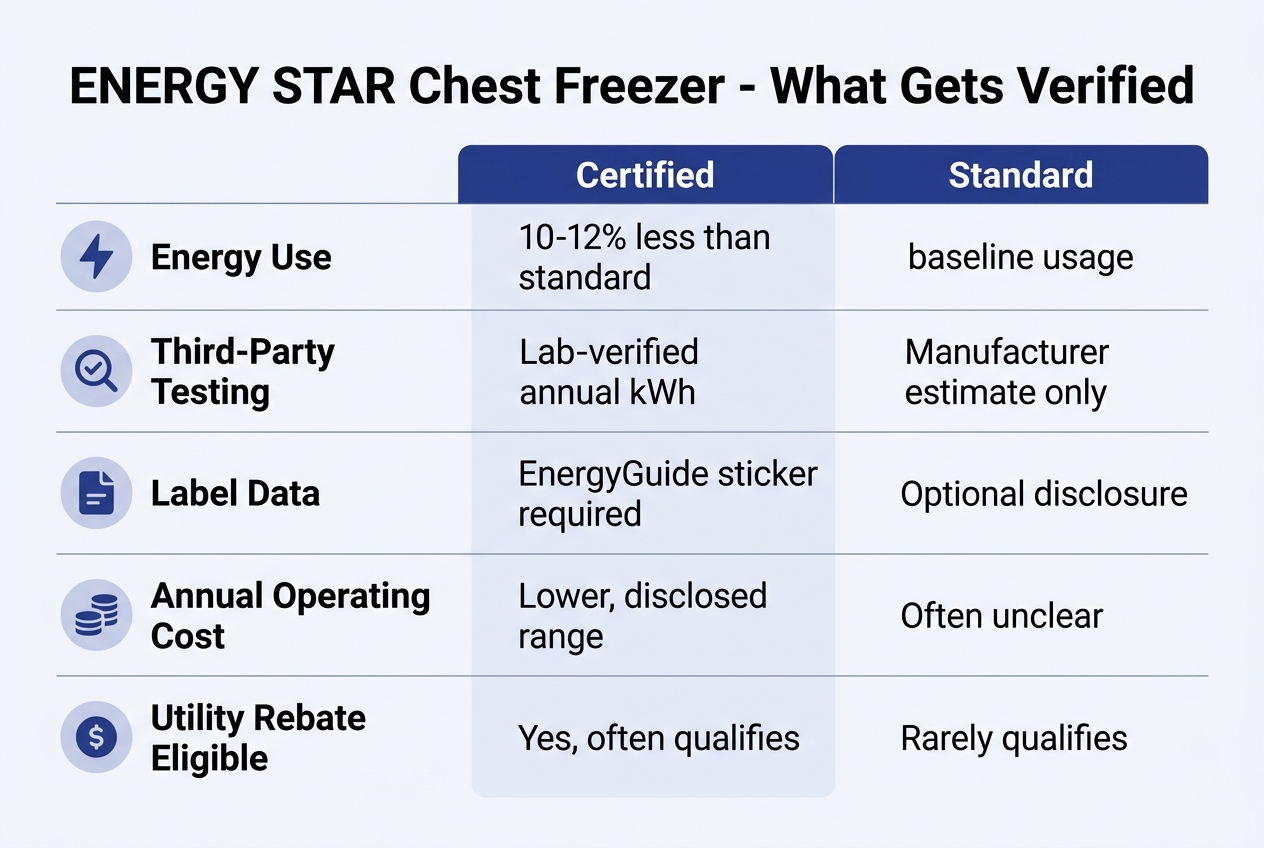
That yellow sticker on every freezer isn’t marketing fluff. It’s generated from standardized test procedures run by an accredited lab, using a fixed ambient temperature and a set door-opening cycle to estimate real-world use. The number you want is the kWh/year figure, usually printed in bold near the center. A chest freezer in the 200-300 kWh/year range is typical for efficient models; anything pushing past 400 kWh/year signals an older compressor design or a poorly sealed lid. Multiply that number by your local rate to see the actual annual cost, and compare it against your current cost of electricity in Louisiana to get a realistic payback estimate.
Don’t confuse basic ENERGY STAR certification with the “most efficient” distinction the program awards each year to a short list of standout models. Certified just means the unit beats federal minimum standards by a set margin. Most efficient means it’s in the top tier of that pool, often 10-20% better than a merely certified competitor of similar size. If you’re comparing two freezers with nearly identical price tags, that distinction is where the real savings hide.
Where to use manufacturer product finders and rebate finders when comparison shopping
Manufacturer websites and the ENERGY STAR product finder let you filter by capacity, defrost type, and certification tier, which saves you from wandering a big-box aisle squinting at stickers. Use these tools before you shop, not after. Narrow your list to three or four models, write down their kWh/year numbers, and bring them with you. It’s a five-minute step that prevents a return trip.
Rebate finders deserve the same attention. Many utilities post searchable databases listing which freezer models qualify for instant discounts or mail-in rebates that month. Availability shifts often, so a model that qualified last quarter might not today. Check before you buy, not after the receipt’s already in the bag.
Utility and manufacturer rebates offsetting upfront cost
A certified freezer often costs more upfront than a bargain-bin model, sometimes by $50 to $150. Rebates close that gap. Many utilities offer $25 to $75 back on qualifying units, and some manufacturers run seasonal cash-back promotions stacked on top. Combined, these can erase most of the price difference, making the efficient choice the obvious one rather than the virtuous one.
It’s worth remembering a freezer’s efficiency on paper only holds up if the room around it cooperates. A unit rated for 300 kWh/year working in a hot, humid garage will run harder and longer than that label implies. Before chasing rebates on new appliances, ask whether the real savings are sitting elsewhere in the house, already measurable with the right diagnostic tools.
Chest Freezer vs Upright Freezer: Specs and Efficiency Tradeoffs
Shape matters more than most shoppers assume. A chest freezer’s lid opens up, so cold air just sits there like water in a bowl. Open an upright door, though, and cold air rolls straight out onto the floor. That single design difference explains most of the gap you’ll see on the yellow EnergyGuide label. Capacity plays a role too, but it’s secondary to how the air escapes every time the unit gets opened.
Manual Defrost vs Frost-Free Energy Costs
Defrost method is the other big lever, and it’s one a lot of buyers skip right past. Frost-free models run heating elements on a timer to melt built-up ice automatically. That’s convenient. It’s also a steady electricity draw that manual-defrost units simply don’t have. A manual chest freezer asks you to scrape ice out once or twice a year; in exchange, it can use roughly half the power of a comparable frost-free upright. Here’s how typical specs stack up:
| Freezer Type | Avg. Capacity | Defrost Method | Est. kWh/Year | Est. Annual Cost* |
|---|---|---|---|---|
| Manual chest freezer | 15 cu ft | Manual | 215 | $30 |
| Frost-free chest freezer | 15 cu ft | Automatic | 350 | $49 |
| Manual upright freezer | 16 cu ft | Manual | 330 | $46 |
| Frost-free upright freezer | 16 cu ft | Automatic | 580 | $81 |
*Based on a national average of about 14 cents per kWh; your rate may run higher or lower.
Bigger isn’t automatically worse, but an oversized unit running half-empty wastes capacity you’re paying to keep cold. Uprights win on organization, obviously, since you can see and grab everything at eye level. If you want the full math behind the label before you decide, learning the benefits of insulating your attic shows how the same air-leakage logic applies to homes, not just appliances.
What to Look for When Comparing Freezer Models
Walking into an appliance store and grabbing the biggest chest freezer on the floor is a common mistake. A bigger box means more surface area to keep cold, and that’s more energy spent cooling empty space. Before you compare specs, figure out what you actually need to store in a given year — a quarter beef, a garden harvest, or just overflow from a small kitchen freezer. That number should drive your size decision, not the showroom floor.
Once you know roughly what size fits your household, the real differences between models show up in the details most shoppers skip past. Here’s what actually separates an efficient unit from one that quietly runs up your bill:
- Capacity matched to real use — a freezer that’s two-thirds full runs more efficiently than one that’s mostly empty air, so buy for your actual food volume, not future hypotheticals.
- Insulation thickness and foam type — most newer models use high-density polyurethane foam in the cabinet walls, and thicker foam (check the spec sheet, not just the outside dimensions) holds cold longer during power outages or lid openings.
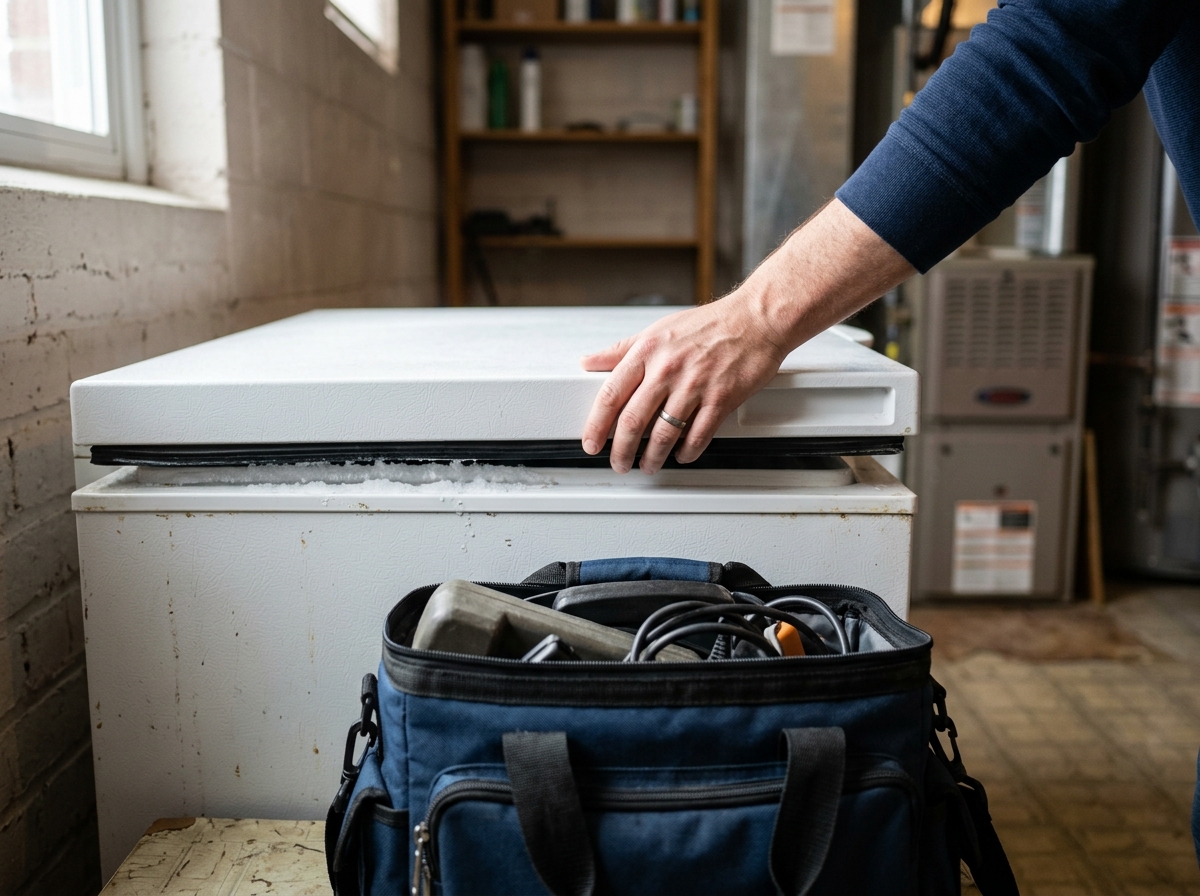
- Seal and gasket quality — run a dollar-bill test, slide a bill into the closed lid and tug; if it slides out with no resistance, the gasket is already failing and the compressor will work overtime.
- Adjustable thermostat with an alarm — look for a dial or digital readout plus a high-temperature alarm, since a freezer that drifts a few degrees without warning you wastes energy compensating and risks spoiled food.
- Energy Guide yearly cost comparison — the bright yellow tag lists estimated annual operating cost; stack that number across three or four brands at the same capacity before you decide, since the sticker price rarely tells the real story.
Doors and seals get mentioned constantly by owners comparing models, and for good reason — a worn gasket undoes almost everything else on this list. If you’re also tightening up the room the freezer sits in, learning how attic insulation affects nearby temperatures helps explain why a garage freezer works harder than one in a conditioned basement. Get the specs right, and the freezer does its job quietly for a decade or more.
Freezer Placement and Usage Habits That Cut Energy Use
Where you put the freezer matters almost as much as which model you bought. Even the most efficient compressor has to work overtime if it’s fighting a 100-degree garage in July. Placement and daily habits can swing your actual energy use by a wide margin, regardless of the yellow EnergyGuide sticker. The good news: most of these fixes cost nothing.
Best Practices for Garage or Unconditioned Space Installs
A freezer rated for efficiency still has to work against its surroundings, so the room it sits in deserves some thought. Reviewing guidance like Purchasing Energy-Efficient Residential Freezers makes clear that ambient temperature around the unit directly affects compressor run time and lifespan. Keep these habits in mind:
- Install the freezer in a conditioned basement, laundry room, or mudspace rather than an uninsulated garage or shed where summer heat forces the compressor to run almost nonstop.
- Leave at least two to three inches of clearance on all sides and behind the unit so the condenser coils can shed heat properly instead of trapping it against a wall.
- Keep the freezer reasonably full, since dense, cold contents hold their temperature far better than empty air does, which means fewer compressor cycles after you open the lid.
- Inspect the door or lid gasket every few months for cracks, gaps, or a weak seal; a dollar bill test (close it on a bill and see if it slides out easily) is a quick way to check.
- Defrost manual-defrost units before frost buildup passes a quarter inch, since thick frost acts as insulation and forces the compressor to work harder to maintain temperature.
Garage installs aren’t always avoidable, especially in smaller homes. If that’s your only option, insulated garage doors and sealed wall penetrations help more than people expect, and the same logic behind air sealing living spaces applies to any semi-conditioned space holding major appliances. Small gaps around door trim or outlets let in outside air faster than you’d think. Worth noting, too: a freezer isn’t the only appliance sensitive to installation conditions — the same logic behind proper clearance and airflow is why resources on ac installation for new construction also stress unobstructed space around equipment. None of this is complicated. It’s mostly just common sense people skip because the freezer’s in the garage and out of sight.
When the Real Energy Drain Is the Room Around the Freezer
How a Home Energy Assessment Pinpoints Hidden Heat Loads
A chest freezer tucked in the garage doesn’t run in a vacuum. It runs in whatever temperature surrounds it, and in a Louisiana garage in July, that can mean the compressor is fighting 100-degree ambient heat just to hold zero degrees. Same story in a utility room or an unconditioned addition: if that space leaks air, the freezer works harder, cycles longer, and burns more power than its ENERGY STAR rating ever promised. The appliance isn’t the problem. The room is.
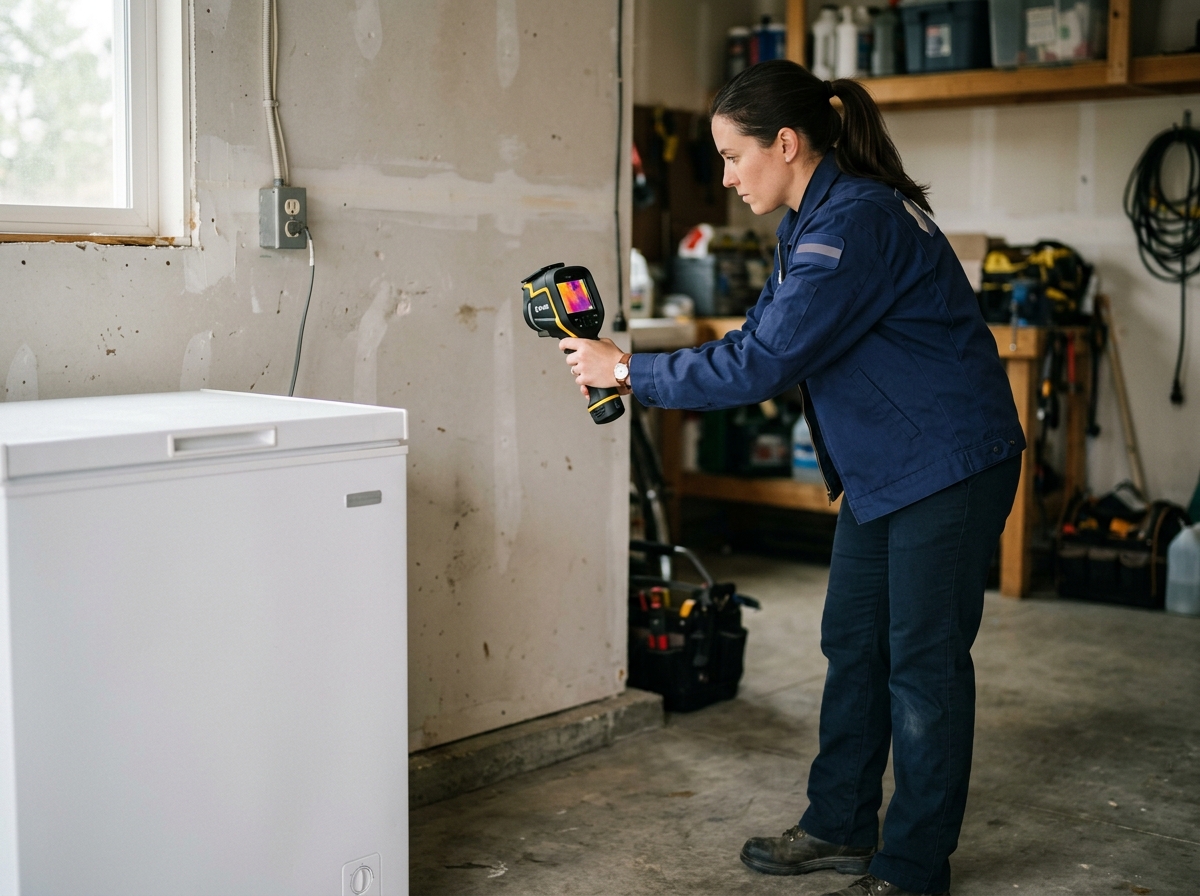
A home energy assessment is how you find out for sure instead of guessing. Blower door testing pressurizes the house and measures exactly how much air is escaping, while thermal imaging shows where outside heat is sneaking past rim joists, attic penetrations, and door trim to reach the appliance area. It’s a diagnostic approach aimed squarely at the space your freezer happens to live in. The report tells you, in real numbers, where that room is bleeding conditioned air.
Garages and additions are usually the worst offenders because they were often built, or converted, with less attention to the building envelope. Gaps around a garage door header, an unsealed rim joist, or a penetration where a wire runs into the attic can add up to a steady stream of heat pouring in. Pinpointing the leak is step one. Fixing it is step two.
Air Sealing and Insulation as a Complement to an Efficient Appliance
Once the assessment flags the trouble spots, air sealing and duct sealing go to work closing them. Sealing cracks around door trim, top plates, and rim joists lowers the ambient heat load the compressor has to overcome, which means fewer run cycles and a lower electric bill, regardless of how efficient the freezer itself is. If ductwork runs through that same garage or utility space, duct sealing keeps conditioned air from leaking out before it ever reaches the rest of the house, which matters just as much for comfort as it does for the freezer.
Insulation does the rest. Attics above garages and additions are frequently under-insulated, sometimes losing 40 percent or more of conditioned air straight through the ceiling. Blown-in cellulose, installed up to R-60, fills those gaps and settles around obstructions in a way flat batts simply can’t match, with depth and R-value verified after the install. That’s a measurable upgrade, not a guess, and it’s a far cheaper path to the same comfort goal than a spray foam retrofit — foam is handled by other contractors, but cellulose paired with targeted air sealing gets you the same rebate-eligible comfort without the foam premium.
One more thing worth checking before the project wraps: combustion safety. If a water heater or furnace shares that garage or utility space, air sealing can change how it drafts. A combustion-safety check confirms the appliance is still venting properly once the house is tighter, so you’re not trading an electric bill problem for a carbon monoxide risk. That’s not a step to skip, and it’s not one to DIY. If the equipment itself needs repair or replacement, that work belongs to a licensed HVAC contractor — the safety check simply confirms what’s already installed is still venting the way it should.
Comparing Upfront Cost, Rebates, and Long-Term Savings
A chest freezer’s price tag only tells half the story. A cheap unit can cost more over 10-15 years than a pricier ENERGY STAR model, once you add up what it pulls from the grid every month. Operating cost, not sticker price, is what actually drains your wallet. Run the math before you buy, not after.
| Freezer Type | Typical Price | Est. Annual kWh | Est. Annual Cost | 15-Year Total Cost |
|---|---|---|---|---|
| Standard, non-certified, 7 cu ft | $230 | 330 kWh | $46 | $920 |
| ENERGY STAR certified, 7 cu ft | $280 | 230 kWh | $32 | $760 |
| Standard, non-certified, 15 cu ft | $400 | 440 kWh | $61 | $1,315 |
| ENERGY STAR certified, 15 cu ft | $460 | 310 kWh | $43 | $1,105 |
Steps to Claim Freezer and Weatherization Rebates
Manufacturer and utility rebates for certified freezers often run $25 to $75 off the purchase, and some utilities add instant discounts at participating retailers. That’s a nice start. But a freezer sitting in a hot, leaky garage still works overtime no matter how efficient it is. Utility-sponsored weatherization programs through Entergy, CLECO, Mississippi Power, Atmos Energy, and Energy Smart often cover air sealing and insulation at little to no cost, including free service for income-eligible households. Pairing the two is where real savings show up.
- Confirm the freezer model number carries current ENERGY STAR certification before you buy.
- Save the receipt and the EnergyGuide label; most rebate forms require both.
- Schedule a home energy assessment to see what else is wasting the savings.
- Submit weatherization and freezer paperwork together where utility programs allow it.
Step three is where homeowners usually get stuck, since every utility wants different forms and documentation. That paperwork can be handled on your behalf instead of you chasing it alone, and the same goes for drafty walls hiding around the freezer; learning what air sealing actually fixes helps you see why a tight room multiplies a freezer’s savings instead of competing with them.
Other Appliances Worth Checking for Efficiency
A chest freezer isn’t the only appliance quietly running up your bill. Refrigerators, clothes washers, dryers, and dishwashers all carry comparable ENERGY STAR ratings, and the gap between an old model and a new one can be just as dramatic as what you’ll find in freezers. A 15-year-old fridge can use twice the electricity of a current ENERGY STAR model. Same story with washers: older top-loaders often use three times the water and energy of efficient front-loaders. Check the yellow EnergyGuide tag before you buy anything, not just the freezer.
In Louisiana and Mississippi, there’s another layer to this. Dehumidifiers and air purifiers run almost constantly in humid months, adding a steady electric load most homeowners never budget for. A mid-size dehumidifier alone can add $15 to $20 a month if it’s working overtime against a leaky, under-insulated house. That’s worth noticing. Replacing one inefficient appliance at a time is a practical way to lower bills without a full remodel; you don’t need to gut the kitchen to see a smaller number on your statement.
The harder question is where your next dollar does the most good. Pairing appliance upgrades with professional energy assessments shows which investment actually saves the most per dollar spent, instead of guessing. Sometimes a new dishwasher matters less than sealing the attic that’s letting conditioned air leak out around it. A blower-door test and thermal scan put real numbers behind that decision, so you’re upgrading what’s actually costing you money, not just what looks newest in the showroom.
An energy efficient chest freezer runs quietest and cheapest when the room around it isn’t fighting against drafts and temperature swings, which is where the bigger picture of a home’s efficiency tends to matter more than people expect. Reviews of air sealing and insulation work often circle back to the same themes: noticeable gains in efficiency, drafts near doors finally resolved, and job quality that holds up over time, all signs that the envelope around appliances like a freezer was part of the problem. A home energy assessment, the kind offered by Big Star Conservation INC., is a reasonable starting point for anyone wondering whether the real issue is the appliance itself or the space it sits in.
