


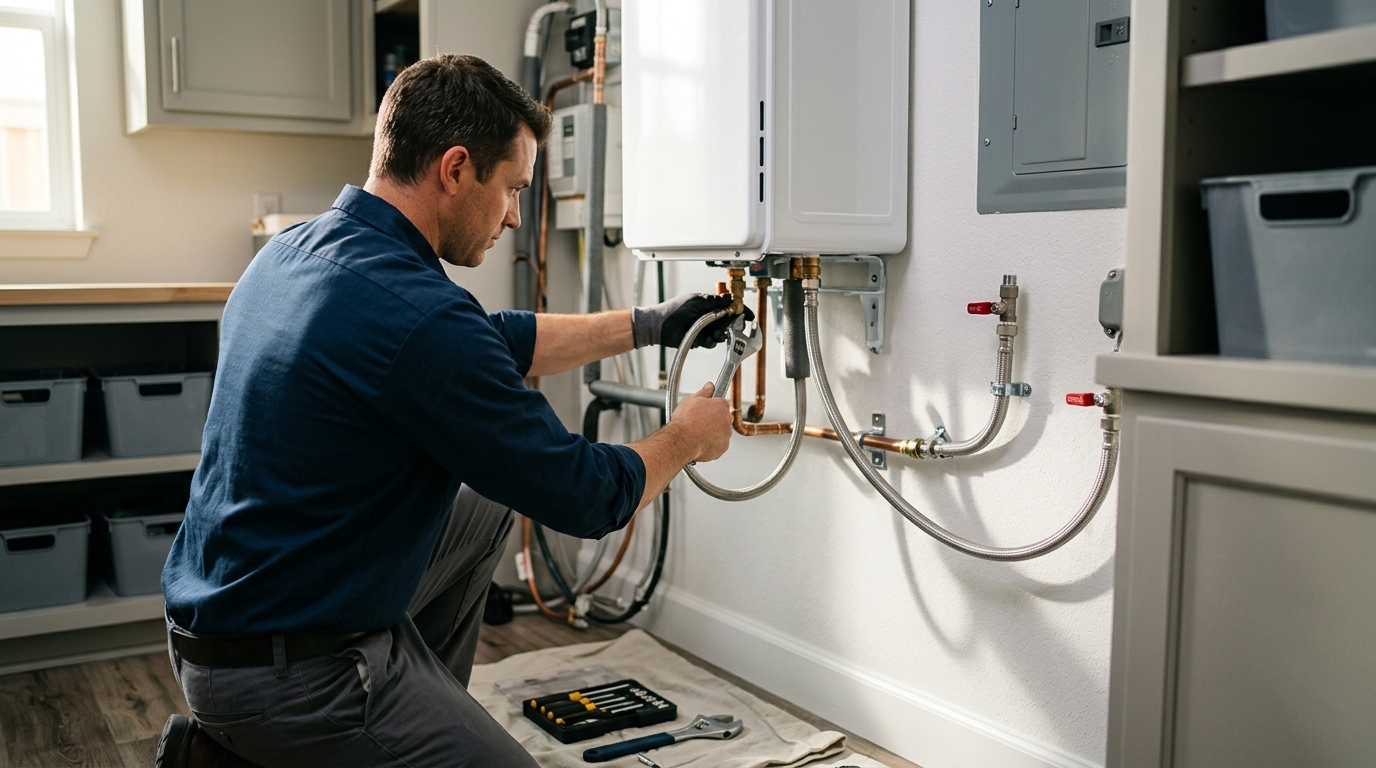
Your water heater is quietly draining your budget. It runs around the clock to keep a tank hot, even when you’re not home. It doesn’t have to be that way. Energy efficient tankless water heaters heat water only when you need it, cutting waste and trimming your utility bills in the process. This guide breaks down what’s changed for 2026, so you can choose a system that actually fits your home and your wallet.
How Energy Efficient Tankless Water Heaters Work
On-demand heating explained
A tankless unit doesn’t keep a big drum of water hot around the clock. It waits. The moment you open a hot water tap, a flow sensor detects movement and fires up a gas burner or an electric heating element to warm the water as it passes through. No tap open, no heating. That’s the whole trick, and it’s why these units are often called on-demand or instantaneous water heaters.
This design wipes out standby heat loss, the slow bleed of energy that happens in a traditional tank as it sits there reheating water all day just to keep it ready. Tank units can lose a noticeable chunk of energy this way, even when nobody’s home. A tankless system skips that entirely, since there’s nothing stored to lose heat from in the first place.
The unit also calculates how much temperature rise is needed based on incoming water temperature and how fast water is flowing, then adjusts burner or element output on the fly. Run a trickle at the bathroom sink and it works lightly. Turn on two showers plus the dishwasher, and it ramps up hard, sometimes hitting its limit. That’s a plumbing question, not just an energy one. It’s part of why sizing matters so much before you buy.
Gas vs. electric tankless models
Gas-fired tankless heaters use a burner to heat water fast, which gives them higher flow rates. But they need proper venting and a steady supply of combustion air to run safely. Improper venting isn’t just an efficiency problem. It can be a safety hazard. That’s why installation details, not just the unit itself, determine whether a gas model performs the way its spec sheet promises.
Electric tankless units skip combustion entirely, relying on heating elements that draw a lot of power in a short burst. That means sufficient amperage and dedicated circuits matter a great deal; an undersized electrical panel can bottleneck performance no matter how efficient the unit is rated. Homeowners shopping this route often start by browsing Tankless Electric Water Heaters to compare flow rates against typical household demand.
Neither type is universally “better.” Gas tends to suit whole-home demand and colder climates, while electric fits smaller households or point-of-use spots like a single bathroom. Whichever you pick, the surrounding home matters too. For instance, understanding the benefits of insulating your attic helps explain why even a perfectly efficient water heater can’t fix heat loss happening elsewhere in the house. For more on how these systems fit into broader home performance, the blog covers related topics in plain language.
Tankless vs. Tank Water Heaters: Key Differences
Efficiency and lifespan comparison
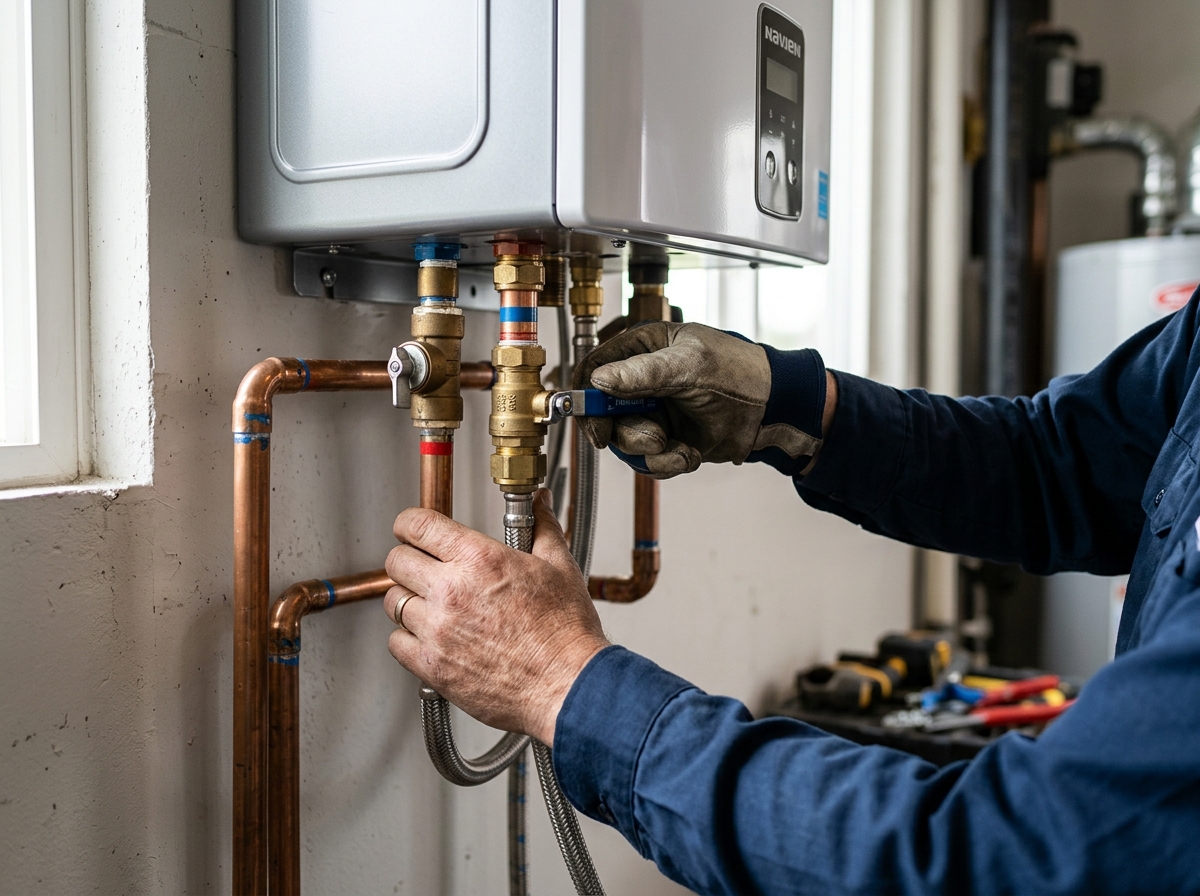
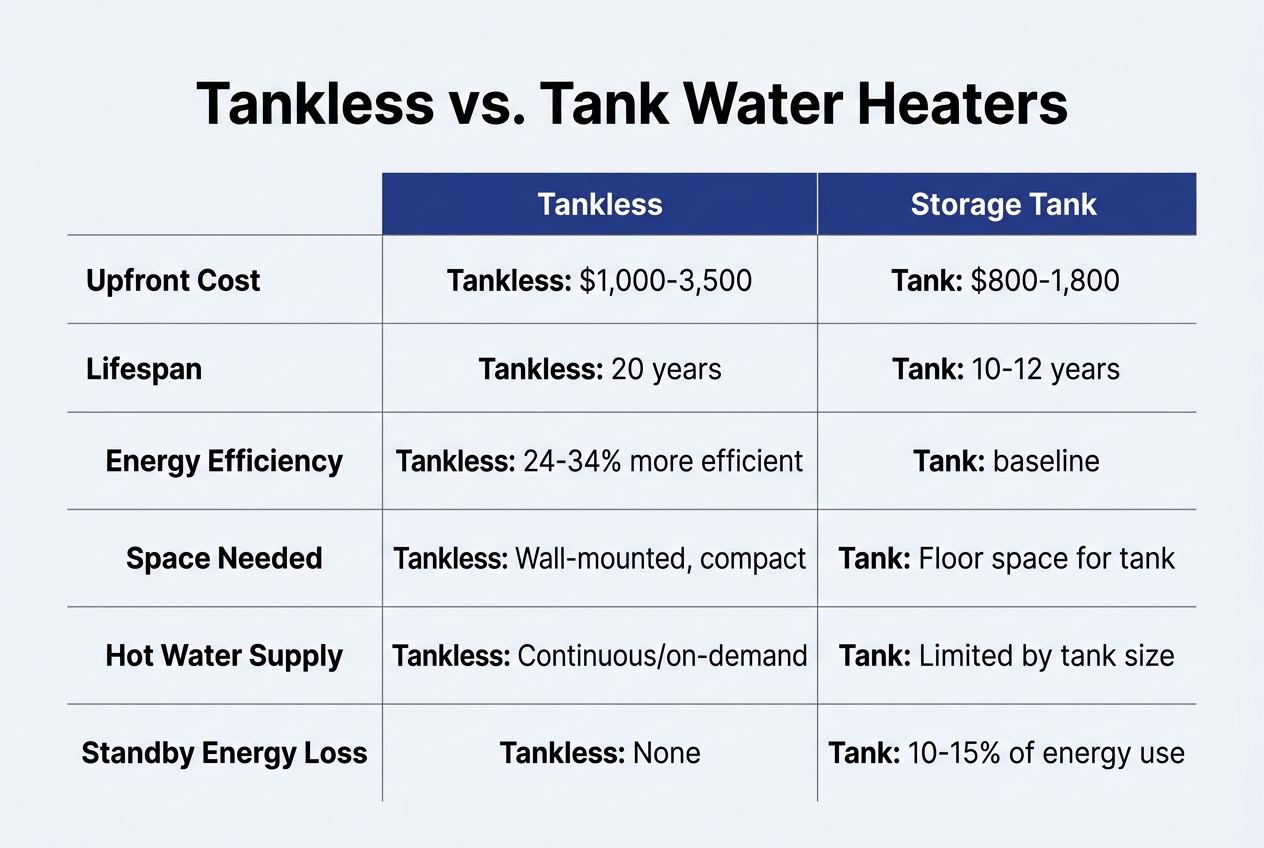
Tank water heaters keep 30 to 50 gallons hot around the clock, whether you need it or not. That constant reheating is called standby loss, and it wastes 10-20% of the energy you’re paying for. Tankless units skip that step entirely, heating water only when a faucet or shower calls for it. Worth noting, though: why tankless electric water heaters aren’t energy star … certified is a fair question, and the answer comes down to how the testing metrics were built, not a flaw in the units themselves. Lifespan tells a similar story. A tank unit typically taps out at 10-15 years from tank corrosion. Tankless models, with no tank to rust through, often run 20 years or more with basic upkeep.
| Factor | Tank Water Heater | Tankless Water Heater |
|---|---|---|
| Standby energy loss | 10-20% of energy use | Near zero |
| Typical lifespan | 10-15 years | 20+ years |
| Hot water supply | Fixed tank volume | Continuous, within flow limits |
| Footprint | Floor-standing, large | Wall-mounted, compact |
| Typical install cost | Lower | Higher, especially with gas/venting upgrades |
Cost and installation differences
Here’s the tradeoff nobody loves: tankless costs more upfront. Gas models often need new venting, and electric versions may require an upgraded circuit or gas line rerouting, work that can add real money to the job. Tank units are cheaper to install since most homes already have the right hookups. But space matters too. A tank unit eats up floor space in a closet or garage, while a wall-mounted tankless unit frees that area up entirely. And capacity works differently: a tank stores a fixed supply that can run out during back-to-back showers, while tankless delivers water continuously, limited only by its flow rate in gallons per minute. If you’re weighing whether the swap pencils out, checking your cost of electricity in louisiana against your current bills is a smart place to start before you commit to either option.
Pros and Cons of Going Tankless
Where tankless excels
Tankless units win big on efficiency, and that’s the whole point of switching. You’re not paying to keep 40-50 gallons hot around the clock, which is exactly why a lot of homeowners start looking into tankless after noticing an electricity bill too high for what their household actually uses. Beyond the bill savings, there’s a real lifestyle upgrade here.
- Lower utility bills, since you’re heating water on demand rather than maintaining a full tank’s temperature 24 hours a day.
- Continuous hot water, so the third shower in a row doesn’t turn cold halfway through.
- Longer lifespan, often 20 years compared to the 10-12 you’ll typically get from a traditional tank.
- Compact footprint, freeing up closet or wall space since there’s no bulky tank to store.
- Reduced water waste, because some models pair with recirculating pumps that cut the wait for hot water at the tap.
Where tankless falls short
Now for the honest part. Tankless isn’t a magic upgrade, and it’s not cheap upfront. Units and installation can run well above a comparable tank system, and if your home’s gas line or electrical panel isn’t sized for it, you’re looking at retrofit costs on top of that. Simultaneous use is another real limit — run the dishwasher, a shower, and the washing machine at once, and a single unit may struggle to keep up. You’ll also need periodic descaling, especially in areas with hard water, or mineral buildup will quietly wreck efficiency over time. For a deeper side-by-side, this breakdown of Tankless Water Heaters: Pros, Cons, and Costs is a solid gut-check before you commit. The right call really depends on household size, how much hot water you actually use at peak times, and what your home’s plumbing and electrical setup can already handle.

What to Look for When Buying a Tankless Water Heater
Certifications and efficiency ratings to check
Not every tankless unit lives up to the hype. Before you buy, look past the sales sheet and dig into the numbers that actually predict your energy bill. A little homework here saves years of regret.
- Check for ENERGY STAR certification, which confirms the unit meets independently verified efficiency benchmarks rather than relying on marketing claims alone.
- Compare Uniform Energy Factor (UEF) ratings across models — the higher the number, the more efficiently the unit converts fuel or electricity into usable hot water.
- Ask about warranty length on the heat exchanger specifically, since that part fails first and costs the most to replace; ten to fifteen years is a reasonable industry standard.
- Consider a condensing gas model if you live somewhere with real winters, since these units capture extra heat from exhaust gases for noticeably higher efficiency in colder climates.
- For a broader rundown on what separates good units from mediocre ones, a well-researched Water Heater Buying Guide is worth skimming before you commit to a brand.
Sizing for your household’s hot water demand
Efficiency ratings mean nothing if the unit can’t keep up with your family. Tankless heaters are rated by flow rate, measured in gallons per minute (GPM), and that number has to match real-world simultaneous use — a shower running while the dishwasher cycles, say. Undersize it, and you’ll get lukewarm complaints all winter.
Confirm the practical side too. Gas units need proper venting, and retrofitting that into an existing wall isn’t always cheap. Electric units demand serious amperage, so check your panel’s spare capacity before you fall in love with a model. If you want the full picture on how sizing fits into a home’s broader performance profile, our about us page outlines how we approach whole-house assessments, and our contacts page has details if you’d rather just ask someone directly.
Tankless Water Heater Costs, Maintenance, and Repair
Typical upfront and installation costs
Let’s talk numbers, because that’s usually the first question. Electric tankless units generally run $500 to $1,500 for the equipment itself, while gas models land closer to $1,000 to $3,000 or more, depending on flow rate and brand. That’s just the unit. Installation is where costs swing hard, especially if your home needs new venting, a bigger gas line, or an electrical panel upgrade to handle the load. A straightforward swap might cost a few hundred dollars in labor. A full retrofit with panel upgrades and rerouted venting can push total project costs well past the unit price alone.
| Cost Factor | Typical Range | Notes |
|---|---|---|
| Electric unit | $500–$1,500 | Lower install complexity, may need panel upgrade |
| Gas unit | $1,000–$3,000+ | Higher flow capacity, needs proper venting |
| Basic installation | $300–$800 | Straightforward like-for-like replacement |
| Venting or gas line upgrade | $500–$2,000 | Common in older homes |
| Electrical panel upgrade | $1,000–$3,000 | Needed for high-output electric models |
Routine maintenance to extend lifespan
Tankless units aren’t maintenance-free, no matter what the brochure implies. An annual descaling flush is non-negotiable in a hard-water region like Louisiana, where mineral buildup can quietly choke the heat exchanger and tank your efficiency. Skip it for a few years and you’ll likely see reduced flow, temperature swings, or error codes. Before comparing specific models, browsing an overview of Best Tankless Water Heater Brands of 2026 can help you gauge which units are known for easier long-term upkeep.
Common repairs include igniter failure on gas units, faulty flow or temperature sensors, and restricted flow from scale deposits. None of these are exotic problems. Most are preventable with that yearly flush and a periodic filter check. Rebates from utility companies and manufacturer incentive programs can also take a real bite out of upfront costs, sometimes covering a meaningful chunk of the install. If you’re weighing whether sealing and insulation upgrades should happen alongside a water heater swap, reviewing a completed portfolio of home performance work shows how these projects tend to overlap in older houses.
Why Whole-Home Energy Performance Matters More Than the Water Heater Alone
How air sealing and insulation affect appliance performance
Buying a new tankless unit and calling it a day is tempting. But that’s only half the equation. A tankless heater draws combustion air and relies on stable indoor pressure to draft properly, and a house full of gaps and thin insulation throws that balance off. Leaky attics, uninsulated walls, and gapped rim joists can waste 40% or more of your conditioned air, which means the heater is fighting a losing battle before it ever heats a drop of water.
Think of it this way: you can install the most efficient appliance on the market, but if warm or cool air is escaping through the attic hatch, recessed lights, and top plates, you’re paying to heat and cool the outdoors. That’s the blunt truth nobody puts on the sales brochure. Sealing those gaps and bringing insulation up to R-38 or higher gives the rest of your home’s systems a fighting chance to perform the way they’re rated to.
This is also where duct sealing earns its keep, since leaky supply and return ducts can quietly rob a heating system of the pressure and airflow it needs to run efficiently. Combine that with proper attic and wall insulation, and suddenly the equipment upgrade you paid for actually shows up on your utility bill.
Combustion safety after weatherization upgrades
Here’s the part homeowners rarely think about: air sealing changes how a house breathes. Tighten up a home without checking combustion appliances, and you risk backdrafting, where exhaust gases get pulled back indoors instead of venting outside. That’s not a small detail. It’s a safety issue, and it’s exactly why combustion-safety checks exist after any sealing or insulation project touches a home with a gas water heater or furnace.
A proper check measures draft, spillage, and carbon monoxide levels under worst-case depressurization, meaning exhaust fans, dryers, and range hoods all running at once. If a water heater fails that test after air sealing, a technician can add makeup air or adjust venting before it ever becomes a hazard. Skipping this step is a bit like tightening every window in a house and hoping the furnace figures it out on its own. For anyone shopping efficiency ratings, it’s also worth knowing how the federal guidance on Whole Home Tankless Gas Water Heaters ties performance benchmarks to safe, proper installation.
A full home energy assessment, complete with blower door and duct blaster testing, is what actually pinpoints where the dollars are leaking out, often in places you’d never guess, like a bathroom exhaust fan chase or an unsealed attic knee wall.
Maximizing Savings: Utility Programs, Rebates, and Local Support
Available utility incentive programs in Louisiana and Mississippi
A new tankless water heater is a smart upgrade. But paying full price for it? Not always necessary. Regional utilities across Louisiana and Mississippi run rebate and incentive programs designed to lower the cost of efficiency upgrades, and most homeowners never even check whether they qualify. Providers in this space typically work with several major programs, including:
- Entergy’s efficiency programs, which often cover a portion of qualifying home performance upgrades for residential customers;
- CLECO’s incentive offerings, aimed at reducing the upfront cost of insulation, sealing, and equipment upgrades;
- Mississippi Power’s residential efficiency rebates, available to eligible homeowners across its service territory;
- Atmos Energy’s conservation programs, which focus on gas appliance efficiency and related home improvements;
- Energy Smart initiatives, which frequently fund assessments and weatherization work at reduced or no cost for income-eligible households.
Eligibility rules shift from year to year, so it pays to ask early rather than assume you’re out of luck.
Letting professionals handle rebate paperwork
Here’s the honest truth: rebate paperwork is tedious. Forms vary by utility, documentation requirements change, and a single missing signature can delay a payout for weeks. That’s why many local businesses now include paperwork handling as part of the job, submitting everything on the homeowner’s behalf. It’s one less headache for you, and it means rebates actually get claimed instead of forgotten in a drawer. Bundling matters too. A BPI-certified professional can pair water heater upgrades with air sealing, duct sealing, and insulation, and those combined improvements often qualify for stacked incentives that a standalone appliance swap wouldn’t. Before spending a dime, it’s worth scheduling energy assessments to see which upgrades your home actually qualifies for. If you’re still weighing whether the technology itself is worth it, this Are tankless water heaters really more efficient? : r/Plu… discussion offers candid, real-world opinions from people who’ve made the switch. Either way, booking an assessment is the fastest way to find out what’s on the table.
If a tankless unit is still on your list, the installation itself will come from a licensed plumber or HVAC contractor — that’s simply how that work gets done. Before committing, though, it’s worth knowing how much hot water your household actually wastes and whether your existing venting and combustion appliances are operating safely, which is the kind of thing a combustion safety check at Big Star Conservation INC. is meant to answer. Sealing ducts and air leaks or adding blown-in cellulose often takes a bigger bite out of the energy bill than the water heater ever will, so learning where your home stands first tends to make the rest of the decision much clearer.
