



Dry winter air can crack your skin, aggravate your sinuses, and even drive up your heating costs as your home works harder to feel comfortable. Finding the right balance of moisture shouldn’t be a guessing game. This guide from Big Star Conservation compares popular models on the things that matter most: energy efficiency, coverage, and everyday reliability. Here’s what actually works in 2026.
How to Choose the Best Home Humidifier
What to Look For
Spec sheets only tell part of the story. Compare every unit on the same six points: tank capacity, run time on a single fill, noise level at night, ease of cleaning, humidistat accuracy, and resistance to mold or bacteria buildup inside the tank. A machine that reads 45% when the room actually sits at 38% isn’t just annoying. It wastes money and tricks you into thinking your air is fine.
Match the unit to the room it will actually run in, whether that’s a bedroom, a nursery, or an open-concept living space. Real run time between refills and noise on the lowest setting often differ from the numbers on the box, so owner reviews are worth reading before you buy. Curious what real owners say holds up long-term? This Best HUMIDIFIER you’ll recommend that really works well … thread is a good place to start.
Why Home Envelope Matters Alongside a Humidifier
Here’s the part most buying guides skip: your humidifier is only as good as the room it’s fighting for. In a leaky house, humidified air escapes through gaps around windows, attic hatches, and rim joists almost as fast as the machine can produce it. That’s why homes with poor air sealing report the same complaint over and over: “I run it constantly and nothing changes.” It’s not the humidifier. It’s the envelope.
A properly sealed, well-insulated home holds moisture where you want it instead of leaking it into the attic or outdoors. Learn more about the benefits of insulating your attic, since attic leaks are one of the biggest culprits behind dry winter air. For larger homes that need more than a single unit can handle, a whole home humidifier installation paired with a dedicated provider’s air sealing work tends to beat any standalone machine.
Top Pick: Levoit LV600S Smart Hybrid Ultrasonic Humidifier
Standout Features
The number that matters most here is output. Levoit lists up to 550 mL of mist per hour on the warm setting, 300 mL per hour on cool, and an effective range of 430 to 753 square feet. That’s a living room, a primary suite, even an open-concept kitchen and den combo. Coverage claims vary a lot between brands, so compare rated output and room size against the space you actually need to humidify. Output like this is a big part of why the LV600S sits near the top of most Best Humidifiers lists, not just ours.
What makes it a true year-round unit is the hybrid design. You get ultrasonic cool mist for summer and a warm mist setting for winter, so you’re not buying a second machine when the seasons flip. That flexibility alone justifies the price gap over single-mode competitors.
The smart features round it out nicely. App control lets you set a target humidity percentage, and the built-in sensor adjusts output automatically instead of blasting mist all night. Sleep mode drops the display lights and the noise to a near-silent hum — good news if you’re a light sleeper. Combined with tighter home insulation, this kind of steady, low-effort climate control is part of why some owners notice their electricity bill too high readings finally level off in shoulder seasons.
Flaws
Nothing’s perfect. The 1.5-gallon tank is a workhorse, but full, it’s heavy and a little awkward to carry to the sink without sloshing. Second issue: hard water. If your supply is mineral-heavy, expect the occasional dusting of white residue on nearby furniture — the same buildup that eventually clogs appliances the way scale collects inside a tank and drives water heater element replacement jobs. Distilled water solves it, but that’s an extra step most people won’t bother with. Worth noting, too: pairing a humidifier with smart shading can help stabilize a room’s overall climate, and Automated Blinds Vs Automated Shades Which Smart Window Treatment breaks down which option fits that goal best.
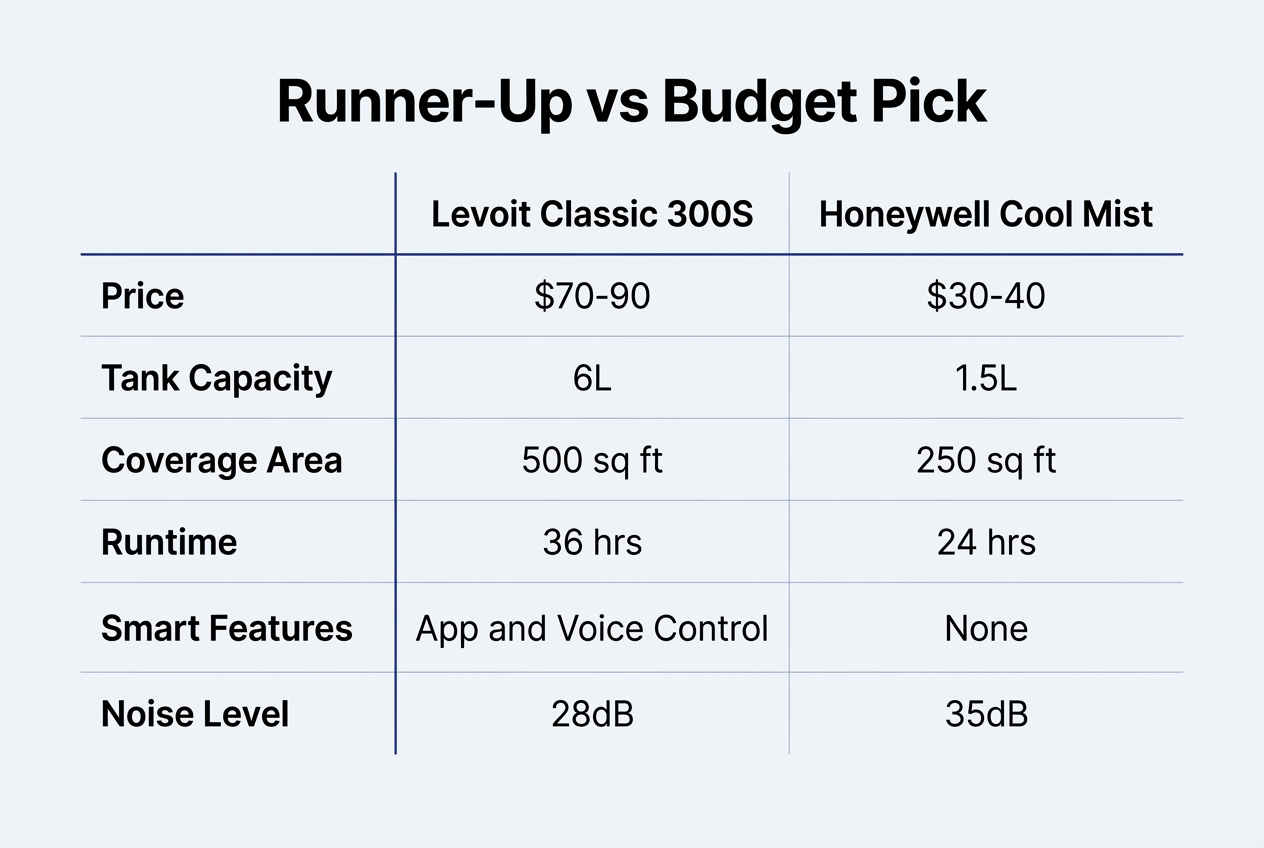
Runner-Up and Budget Pick Compared
Not everyone needs the flagship model. If you want fewer bells and whistles, two units stand out for different reasons: the Levoit Classic 300S and the Dreo HM311S. Both landed on several respected lists, including The 6 Best Humidifiers of 2026 | Reviews by Wirecutter.
Levoit Classic 300S: Quiet and Simple
The 300S trims the extra features but keeps the essentials. Its app control is easy to set up, and it runs noticeably quieter than the LV600S at night. Good pick for bedrooms where silence matters more than smart-home extras.
Dreo HM311S: The Budget Workhorse
This one skips the app entirely. Just a dial and a couple buttons. It’s not fancy, but it humidifies a small-to-medium room just fine, and the price makes it an easy first purchase.
| Model | Tank Size | Coverage Area | Price Tier | Noise Level |
|---|---|---|---|---|
| Levoit Classic 300S | 6 liters | Up to 500 sq ft | Mid-range | Very quiet (~30 dB) |
| Dreo HM311S | 4 liters | Up to 300 sq ft | Budget | Moderate (~35-38 dB) |
Room size should drive your decision here. The 300S suits a large bedroom or open living space, while the HM311S is better for a nursery or home office. Either way, running a humidifier changes your energy use a bit. If you’re curious how that fits into your monthly bill, it helps to understand the cost of electricity in louisiana. Worth noting too: a humidifier can’t fix a drafty room. If cold air keeps sneaking in, air sealing does more for comfort than any humidifier setting ever will.
5 Best Home Humidifiers for Specific Needs
Not every household has the same problem. Some homes have one dry room that never holds moisture. Others need even coverage across a whole floor plan without daily babysitting. Below are five models worth knowing about, each solving a different situation you might actually be dealing with.
- Vornado EV3 Evaporative Whole Room Humidifier — uses Vornado’s signature vortex airflow to push humidified air further than most evaporative units, making it a solid pick for open-concept living rooms or bedrooms with poor circulation near vents.
- Blueair InvisibleMist H35i — pairs a built-in UV-C sanitation chamber with a sealed water tank, which matters if you’ve ever opened a humidifier tank and found a film you didn’t want to think about.
- Venta LW25 Original — a cold-water washing system rather than a filter, so it needs less frequent cleaning and handles spaces up to roughly 400 square feet without much fuss.
- Levoit LV600S: our top overall pick, thanks to hybrid ultrasonic output, smart app controls, and a built-in humidity sensor.
- Dreo HM311S — a compact, budget-friendly option built for renters, dorms, or small bedrooms where a full-size unit would be overkill.
If you’re weighing these options against your actual indoor air quality, it helps to see them tested side by side rather than take a spec sheet at face value. This clip where Consumer Reports experts look at the best humidifiers for… different home sizes is a useful gut check before you buy. Humidity control is just one piece of a bigger comfort puzzle, though. Drafty rooms and leaky ducts undo a humidifier’s work fast, which is why many local businesses pair moisture control with broader home performance fixes. It’s also worth mentioning that inconsistent water heater performance sometimes traces back to a simple water heater thermostat replacement, a detail homeowners often overlook. For a fuller picture of how comfort, air quality, and efficiency connect, our services page covers the diagnostic side of that equation.

Ultrasonic vs Evaporative vs Warm Mist: Which Type Fits Your Home
Every humidifier does the same job in a different way, and that difference matters more than the price tag. Pick the wrong mechanism and you’ll deal with white dust on furniture, a filter you forgot to buy, or a nursery that’s too warm at 2 a.m. Here’s the breakdown before you shop Humidifiers in person or online.
Pros and Cons by Type
Ultrasonic units use a vibrating plate to shoot a fine, cool mist into the air. Silent operation. Great for bedrooms. But tap water minerals turn into that dusty white film on furniture — you’ll want distilled water. Evaporative models pull water through a wick, and a fan pushes air through it. Their output naturally drops as the room gets more humid, so they are less likely to over-humidify a room. Downside: wick filters need swapping every 1-2 months. Warm mist machines boil water, which kills most bacteria before it hits the air, but they nudge room temperature up and pull more electricity.
| Type | Best For | Maintenance | Energy Use |
|---|---|---|---|
| Ultrasonic | Bedrooms, nurseries, quiet spaces | Weekly clean, distilled water recommended | Low |
| Evaporative | Allergy sufferers, larger rooms | Wick filter replacement every 1-2 months | Moderate |
| Warm Mist | Sick rooms, cold-weather use | Daily rinse to prevent mineral buildup | Higher |
| Whole-Home (Ducted) | Entire house, consistent humidity | Seasonal filter/pad change | Moderate |
Evaporative models are a common pick for allergy-prone households, since their output tapers off as the air gets more humid, making it harder to push humidity into the range where mold grows. Nurseries call for ultrasonic — quiet, cool, no burn risk. Whole-home comfort is a different conversation entirely, tied to your HVAC system rather than a countertop unit. Speaking of household systems that need occasional attention, don’t ignore basics like water heater relief valve replacement while you’re auditing home equipment. And if you’re curious how any site handles your data, check the privacy policy before signing up for newsletters or product alerts.
How to Clean and Maintain a Humidifier So It Doesn’t Grow Mold
Humidifiers get gross fast, and here’s why: warm, standing water is basically a nursery for bacteria and mold spores. Add in mineral dust from tap water and a dark tank, and you’ve built the perfect breeding ground within days, not weeks. Stagnant water is the enemy, not the machine itself. Most people skip this step. It shows — usually as a smell you can’t quite place.
Weekly Cleaning Routine
Treat your humidifier like a dish you use every day, because that’s basically what it is. A little consistency goes a long way toward keeping the air in your home actually clean instead of just humid.
- Dump and refill the tank daily with fresh water, since overnight sitting water starts growing bacteria almost immediately.
- Deep clean weekly using a mix of white vinegar and water, or a 3% hydrogen peroxide solution, letting it sit for 30 minutes in the tank before rinsing thoroughly.
- Scrub the base and any crevices with a soft brush or old toothbrush, since mineral scale and slime love to hide in corners.
- Watch for a slimy film on interior surfaces, a musty or sour smell, or cloudy water, all of which mean mold or bacteria have already taken hold.
- Replace evaporative wicking filters every one to three months depending on water hardness, since mineral buildup makes them far less effective and much harder to sanitize.
- Let all parts air-dry completely before reassembling, because trapped moisture undoes the whole cleaning effort.
These habits matter for the same reason homeowners care about duct sealing: both are about controlling what actually circulates through your air. A clean humidifier supports your indoor air quality goals instead of quietly working against them. If you’re managing humidity across an entire house rather than one bedroom, it’s worth reviewing options like Whole House Humidifiers | Large Home …, which are built with easier long-term maintenance in mind.
Best Home Humidifiers for Whole-House Comfort vs Single-Room Units
When a Portable Unit Isn’t Enough
A portable humidifier can do a lot for one bedroom or a nursery. But it stops at the doorway. Run it in the living room and the upstairs bathroom still feels like a desert while the basement stays damp. That’s just physics — a tabletop unit only moves moisture a few hundred square feet, tops. If your house has more than one or two rooms with dry-air complaints, you’re fighting a losing battle with a single machine.
Whole-house humidifiers take a different approach entirely. They tie into your existing HVAC ductwork, so moisture gets distributed through the same vents that already heat and cool every room. No refilling tanks daily, no hauling units from room to room. It’s set-it-and-forget-it comfort, and it’s the only real fix once dryness becomes a house-wide problem rather than a one-room annoyance.
Connecting Humidity Problems to Home Air Leakage
Here’s something most people don’t expect: uneven humidity is often the exact same problem as uneven temperature. Leaky ducts and gaps around attic penetrations, rim joists, and top plates let conditioned air escape and let outside air sneak in. That swap doesn’t just mess with your thermostat readings. It drags unconditioned, often dry, air right into your living space and undoes whatever your humidifier just did.
Before spending money on a whole-house system, it’s worth finding out where the air is actually going. A home energy assessment (blower door test, duct blaster test, thermal imaging) pinpoints exactly where conditioned air and moisture are leaking out, and it’s usually the missing step homeowners skip before buying equipment.
A well-sealed, properly insulated home simply holds humidity steadier. Less strain on the humidifier, fewer swings, lower bills. Skip the sealing, and you’re just humidifying the outdoors.
A humidifier can only do so much if your home’s ducts and walls are leaking conditioned air in the first place, which is why it’s worth pairing that purchase with a proper energy assessment. The BPI-certified team at Big Star Conservation, Inc. in Elmwood, LA uses blower door tests and thermal imaging to find exactly where your home is losing comfort, then seals and insulates it for good. Stop by their office at 1500 Edwards Ave Suite J, or call +1 (504) 305-3276 to book an appointment in under five minutes and start feeling the difference.
